The OG of IT - Joe Popper

Author name: The OG of IT - Joe Popper

Blog, March 2026 Blogs

Why Peace of Mind Is a Legitimate Business Investment

Most business owners carry a quiet tension that never fully goes away.

It shows up in small moments.

You wonder what might break while you’re gone.

You ask yourself if your team could keep working if something failed overnight.

It’s the unspoken weight of knowing that if everything stops, it stops on your watch.

This isn’t dramatic stress; it’s constant. You stay half-checked in even when you’re off. You double-check things and feel responsible for problems you can’t fully control.

That background worry has a cost. It steals focus, adds friction and makes leadership heavier than it needs to be.

Peace of mind isn’t about comfort. It’s about running the business better with a clear mind.

How worry affects your focus as a leader

When you’re worried about what might break, part of your attention is always elsewhere. Even on good days, some mental energy is tied up in “what if” instead of “what’s next.”

That shift matters more than it seems. Decisions take longer because the timing never feels safe. Planning starts to feel reactive instead of intentional. You spend more time guarding against disruption than building forward momentum.

It’s like trying to think clearly while holding a weight in one hand all day. You can still function but it takes more effort than it should.

When you’re confident, you can recover quickly. You stop rehearsing problems before they happen. You stop holding your breath every time something changes.

That clarity brings your focus back to where it belongs: on leading, deciding and moving the business forward.

How your confidence affects your team

Confidence works like gravity. You don’t see it, but it quietly pulls everything into alignment.

Your team takes cues from you, especially when things feel uncertain.

If you’re uneasy, they sense it.

People move more cautiously.

Small mistakes feel riskier than they should.

Work slows because no one wants to be the one who causes a problem.

When recovery is predictable, the dynamic changes. People work with more confidence because they know issues will be handled. Small problems don’t derail the day. Work keeps moving instead of stalling.

Peace of mind doesn’t just help you. It helps everyone work better and stay productive.

Decision-making when something actually goes wrong

When something breaks, pressure takes over fast.

People rush to fix whatever’s in front of them.

Quick workarounds stack up.

Communication gets messy as everyone jumps in at once.

When you know recovery is covered, the response changes.

You get things stable first, then look at what happened.

Conversations stay clear.

You stay calm because the business isn’t about to grind to a halt.

That’s not a technical edge. It’s operational maturity, and it’s the difference between scrambling in the moment and responding with confidence.

Why this matters more when you’re running lean

When you’re running a lean business, everything hits harder. There’s no extra capacity to absorb disruption.

If one person is offline, it shows.

If work pauses, everyone feels it.

When something breaks, the impact is immediate and personal.

There’s also less room for distraction. Every hour spent worrying, waiting or chasing updates is an hour not spent serving customers or delivering results.

In an environment like this, peace of mind becomes leverage. It lets you operate with confidence instead of bracing for impact. It frees you from carrying every risk in your head, so that you can focus on execution and growth.

Backup and recovery as delegated worry

Think of backup and recovery like insurance for peace of mind. You don’t invest in it for the bells and whistles. You invest in it for the relief of knowing the burden isn’t yours alone.

Every leader knows the quiet tension of “what if.”

What if something breaks while you’re away?

What if the team stalls tomorrow?

What if a small issue turns into a long, expensive interruption?

Those questions may not sit in front and center, but they’re always there in the background.

Backup and recovery changes that equation. It replaces uncertainty with clarity. Instead of hoping nothing goes wrong, you know the business can get back on its feet quickly when it does.

The risk doesn’t disappear, but the responsibility shifts. You feel lighter and gain clarity. And that’s the real return on investment.

Peace of mind protects momentum

A clear mind isn’t just nice to have. It’s a real business advantage. Peace of mind is what makes it possible.

When recovery is fast and predictable, you don’t worry about the business stalling. Issues still come up, but they don’t drain your time or knock things off course.

You don’t need flawless systems. You need a business that keeps moving under pressure.

If you’re still carrying that risk on your own, it may be time to hand it off and focus fully on growth.

Shift from guarding the business to growing it. It all starts with a 10minute discovery call.

Blog, March 2026 Blogs

The Hidden Yet Easily Preventable Causes of Downtime

When you hear the word downtime, what comes to mind? You might imagine a major storm, a power grid failure, a data breach or a sophisticated cyberattack. These are dramatic events, and while they do happen, they’re not the most common reasons why work grinds to a halt.

In reality, downtime is rarely dramatic. It’s usually something small and ordinary, the kind of issue that doesn’t seem serious at first but still brings work to a standstill. These quiet problems are the ones most likely to disrupt the day.

Even a short interruption has an immediate impact on your bottom line. A single stalled project or a delayed decision can mean missed opportunities and frustrated customers. The cost is not in the event itself, but in the time lost while your team waits for a solution.

What usually causes downtime?

Let’s look at some of the most common everyday scenarios that actually disrupt business.

The coffee spill:
It happens in an instant.
A drink tips over onto a laptop.
The screen flickers and goes dark.
The device won’t turn back on.

Work stops immediately. The affected employee can’t access their emails, project files or calendar. Colleagues pause as everyone figures out what to do next. Is their data gone? Can their work be recovered? Projects stall, deadlines slip and people wait.

A single, simple accident can stall a person’s entire contribution for a day or more if recovery is not fast. The problem isn’t the spilled coffee. It’s the hours of productivity lost while managing the aftermath.

The accidental deletion:
This is a quiet mistake. A crucial file is deleted, or different data is saved over the only good copy of the file. No one notices until the file is urgently needed for a client deliverable or an important report.

Then, the search begins. Time is wasted combing through emails, shared drives and old folders. Panic starts to build as the clock ticks. Eventually, your team must decide whether to recreate the work from scratch or admit a delay to a customer.

This transforms a small error into a significant delay. A task that should take minutes now consumes hours. This loss is entirely due to the difficulty of recovery, not the initial mistake.

The update that didn’t go as planned:
Routine maintenance is part of business. You apply a software update or a new security patch. It should be quick, but something goes wrong. An application behaves strangely or the system doesn’t load properly.

Work pauses. The person who performed the update or someone they call for help tries to diagnose the issue. What should have been a five-minute task becomes a half-day investigation.

A failed update isn’t the real issue. The problem is when there’s no quick path back to a working state, turning routine maintenance into extended downtime.

Aging equipment that finally gives up:
Hardware doesn’t last forever. Devices slow down and become less reliable. One day, the faithful computer or server that has been humming along for years kicks the bucket. The issue was predictable, but the timing never is.

Now, the focus shifts from the failure itself to the recovery. How long will it take to get a new machine? How do we restore all the software and data? Work piles up. Calls go unanswered. Orders can’t be processed while solutions are figured out.

Old equipment doesn’t directly cause downtime; the slow recovery from its failure does. The delay is what hurts your business.

The common thread: Work stops while people wait

In every one of the above examples, the same results occur.

  • People can’t work.
  • Decisions stall.
  • Customers wait.
  • Momentum is lost.
  • The longer it takes to recover, the greater the financial and reputational impact.

Downtime is fundamentally a business problem, not a technology problem. The spilled coffee is part of life. The accidental deletion is human error. Updates and aging hardware are inevitabilities. The real question for your business is: What happens next?

Why fast recovery changes everything

The goal isn’t to prevent every possible problem. That’s impossible. Things will go wrong. The real goal is to get back to work quickly and predictably.

This isn’t about fear or complex technology; it’s about simple resilience. Fast recovery makes small problems forgettable. When you can restore a file in minutes or have an employee working on a new device in an hour, the incident fades into the background.

  • When recovery is fast, work continues.
  • Customers aren’t impacted.
  • Team stress stays low.
  • You contain the cost of the incident to a minor hiccup rather than a major disruption.
  • Getting your team back to work matters infinitely more than what went wrong in the first place.

Make downtime a non-issue for your business

If you’re not sure how quickly your business would recover from one of these everyday issues, let’s talk.

Schedule a 10-minute discovery call to walk through what happens when something goes wrong and how to make getting back to work fast, predictable and stress-free.

Blog, March 2026 Blogs

Your Business Needs Fewer Surprises, Not More IT Tools

It often begins with something small.

Picture a busy morning. A proposal is almost ready, a customer is waiting and the day feels like it’s on track. Then someone can’t find the file they just saved. Another screen freezes. A task that should take minutes suddenly stalls.

No one panics. People try quick fixes or move on to something else. But the rhythm is broken. What should have been a smooth handoff turns into waiting, rework and frustration.

These moments are easy to dismiss. They don’t feel like downtime. But over time, they chip away at productivity and focus. Often, the real issue isn’t the glitch itself. It’s the pause that follows, when no one is sure what to do next.

If a file disappeared or a system stopped working today, would your business keep moving, or would everything slow down while someone figured it out?

More tools usually means more confusion

When businesses hit interruptions like this, the instinct is almost universal: Add another tool.

  • A tool for safely backing up your files.
  • An online storage tool that keeps your files updated.
  • An add-on safety tool that promises extra protection.

Each choice makes sense on its own. Over time, though, your decisions start to look less like a strategy and more like a junk drawer full of tools that might help but no one’s quite sure which one does what.

On a normal day, this is fine and everything runs. The trouble shows up when something breaks.

That’s when the questions start. Who can fix this? Where do we even begin? Has anyone tried this before? And the most familiar one: Whose job is this?

While those questions are being answered, work stays paused. That pause is where delays quietly become costly, not because the issue is severe, but because the next steps are unclear.

It’s a bit like losing the TV remote in your couch cushions. The TV itself works fine, but until someone digs around and finds the remote, you’re stuck staring at a blank screen.

The issue isn’t the technology; it’s the scramble to figure out what to do next.

That’s why even businesses with plenty of technology can still feel unprepared when something breaks.

How an IT service provider reduces uncertainty

This is where working with an IT service provider changes your experience.

Instead of managing a shiny collection of tools, there’s clear accountability. Everything is set up correctly, tested and ready before it’s ever needed, so you aren’t left making decisions under pressure or guessing what to do next.

An IT partner does more than install systems. They bring order by preparing ahead, checking that things work and assigning responsibilities clearly.

When something goes wrong, there’s no confusion about what happens next. The responsibility is taken off your shoulders. Our role is to contain interruptions quickly, so they don’t snowball into disruptions that cost time, money or trust.

That shift replaces reaction with confidence. It reduces stress for business owners and their teams, and keeps work moving when it matters most.

Think of it as the difference between trying to fix a leaky faucet yourself and having a plumber on call. One involves guesswork. The other is handled before the water hits the floor.

What ‘handled’ looks like in practice

Businesses like yours don’t need to solve every problem. What matters is removing uncertainty. That’s what happens when things are prepared and handled the right way.

If a file disappears, it’s restored quickly. There’s no panic, no scramble and no guessing which system to check first.

If an update causes issues, your business gets back on track without a long delay. Work continues while the problem is addressed.

If a computer fails, productivity doesn’t come to a halt. The goal isn’t perfection, it’s continuity.

If something suspicious happens, there’s clear guidance on what to do next. You aren’t left wondering how serious it is or whether you’re overreacting.

The businesses that perform best aren’t the ones with the most tools. They’re the ones that can absorb disruptions without losing momentum. That kind of confidence doesn’t come from buying more software.

It comes from knowing someone has already thought through the what-ifs and tested the answers.

Stop buying tools for someday. Start investing in certainty every day.

It’s easy to buy technology for hypothetical situations. It’s harder to build confidence for the ones that actually happen.

Problems don’t announce themselves. They show up on busy days, during deadlines or when key people are unavailable. In those moments, clarity matters more than capability.

Downtime should be forgettable. It shouldn’t dominate the day or pull attention away from customers and priorities.

If your current setup leaves you wondering what would happen next, that uncertainty is already costing you more than you realize.

Want fewer surprises when something goes wrong?

Book a 10-minute discovery call and see what “handled” really looks like.

Blog, March 2026 Blogs

Getting Back to Work Matters More Than Preventing Every Problem

Something will break eventually.

It won’t happen on a slow day or wait for a convenient moment. It will happen during a normal workday, when things feel routine and everyone expects work to move forward.

If you run a business, you already know this. That isn’t pessimism. It’s experience.

  • A hard drive fails.
  • A crucial file is accidentally overwritten.
  • A routine software update causes more problems than it solves.

Trying to build a business where nothing ever breaks isn’t realistic. The real goal is making sure your business doesn’t stall when something does happen.

Your resilience isn’t measured by how you prevent problems. It’s measured by how quickly you get back to work.

And here’s the uncomfortable question most leaders don’t ask until it’s too late: If something broke right now, would you know how long it would take to get everyone working again, or would you be finding out in that moment?

Why trying to prevent everything backfires

When you’re responsible for keeping the business running, adding more protection feels like the right move.

  • You add another security product.
  • You implement another backup safeguard.
  • You create another rule for your team.

Each decision is made with good intentions. Each one feels responsible on its own. Over time, this well-meaning approach often creates its own risk: complexity.

On a normal day, that complexity is easy to ignore. The trouble shows up when something breaks.

Work doesn’t resume while you investigate. Customers don’t wait while you troubleshoot.

Instead of restoring and moving on, time is lost figuring out what applies, what works and what to do next. This delay comes at the very moment you can least afford it.

Prevention feels effective, until it isn’t. And when it fails, the lack of a clear recovery plan turns a small issue into a major interruption.

The better question to ask

Rather than ask “how do we make sure this never happens?” resilient businesses ask, “how quickly can we be working again when it does?”

That answer determines everything, including whether:

  • Customers notice a problem or receive seamless service
  • Your team stays productive or loses a day waiting
  • An issue becomes a costly, stressful event or a forgettable footnote

This shift turns backup and recovery from a technical chore into a business strategy.

It’s not about collecting tools. It’s about designing a way of working where interruptions don’t become disasters.

Why recovery speed matters more when you’re lean

When work stops, the impact is immediate.

One stalled project blocks others.

One delayed decision slows progress.

One interruption pulls focus from everything else that matters.

The difference between minutes and hours is often the difference between a brief interruption and a lost day.

Fast recovery is leverage. It limits how much attention, energy and momentum a problem can steal. It ensures one unexpected issue doesn’t take over your entire day or derail your week.

If you’re not sure how quickly your business could recover today, that’s worth a closer look.

What ‘getting back to work fast’ actually means

Fast doesn’t mean building a magical business where nothing ever goes wrong.  It means clarity and knowing how long recovery will take. It means work resumes without panic, scrambling or significant delays.

This predictability is everything. Speed reduces stress because the finish line is visible. Predictability reduces second-guessing because the path is known. Together, they keep your business moving forward, even on days when plans break.

Momentum is what you’re really protecting

At the end of the day, this isn’t about systems or files. It’s about momentum. Momentum keeps your team working, customers served and revenue flowing.

Invoices go out.

Projects move forward.

The business doesn’t freeze.

When you can recover from setbacks quickly, problems lose their power. They become brief interruptions instead of events that define the day.

You protect your focus.
You protect your team’s confidence.
You protect forward progress.

Ready to lay the foundation for a resilient business?

You don’t need a business where nothing ever breaks. You need one that doesn’t stop when something does.

If you’re ready to stop fearing the inevitable mishap and start building a business that bounces back quickly, let’s talk.

Schedule a 10-minute discovery call to walk through what would happen if something broke and how to make fast, predictable recovery your new standard.

Blog, February 2025 Blogs

Why your company is a target: The economics and psychology behind modern cybercrime

If you own or manage a business in the United States and still think, “We’re too small for hackers to notice,” you’ve already slipped into their favorite target category. To many cybercriminals, small and midsize businesses aren’t unimportant; they’re ideal. They move money quickly, use the same digital systems as large enterprises, and often have fewer layers of defense. 

To understand why you’re a target, it helps to see the world through a hacker’s eyes: what motivates them, how much money they actually make from a single successful attack, and why the effort‑to‑reward ratio makes business email compromise or a fake “CAPTCHA” scam so attractive. 

Welcome to the underground economy, a world where a single stolen invoice or manipulated mouse click can buy someone across the world several years of financial stability. 

Table of Content

  • Why Small Businesses Are Targeted

  • The Economics Behind Modern Cybercrime

  • ClickFix and Fake CAPTCHA Attacks

  • Business Email Compromise (BEC) & Invoice Fraud

  • How Attacks Move From Click to Cash-Out

  • Why U.S. Companies Are Attractive Targets

  • How a Security-First MSP Reduces Risk

  • Frequently Asked Questions

Key takeaways 

  • Cybercrime is driven by powerful economics. For many attackers in lower‑income regions, a single $50k$100k payout equals several years of local income, making U.S. SMBs extremely attractive financial targets.  
  • The cybercrime ecosystem runs like a real business. There is a mature underground market with tool developers, access brokers, money launderers, and affiliates, all specializing and profit‑sharing in “crime‑as‑a‑service” models.  
  • Human‑focused attacks like ClickFix and BEC are central. Fake CAPTCHA “ClickFix” prompts trick users into running malicious commands, which then enable mailbox takeovers and business email compromise, a category responsible for about $2.8B in U.S. losses in 2024 alone. 
  • Ransomware remains costly even when fewer victims pay. While some data shows payout volumes dipping, the average cost per ransomware incident, including downtime and recovery, continues to rise, keeping it a highly profitable tactic for criminals. 
  • Disciplined controls and a security‑first MSP can flip the economics. Measures like MFA and conditional access, least‑privilege access, immutable backups, inbox rule monitoring, and strict out‑of‑band payment verification significantly reduce attacker ROI and limit BEC and ransomware damage, especially when coordinated with an MSP and rapid reporting to IC3/FBI. 

The money math: the global value of your $50,000 

Let’s start with the reality that drives most digital crime: simple economics. 

In Russia and several other countries that produce many of the world’s technically skilled hackers, the average worker earns roughly $12,000-$15,000 per year. Even in wealthier regions like Moscow, salaries rarely exceed $1,200 a month. For a financially motivated actor in that context, a single $50,000 payout equals years of income. 

That’s why demands you see on ransomware screens, $50,000, $100,000, even $200,000, aren’t random. They’re calibrated sweet spots: significant enough to change the criminal’s life, but still just low enough that many small businesses consider paying rather than spending months in recovery. 

On cybercrime forums, these economics are discussed openly, like any other business venture. Access brokers sell stolen logins for a few hundred dollars. Ransomware affiliates advertise bulk “phishing as a service.” Money‑laundering middlemen (called “cash‑out” specialists) handle payments for a fee. What we perceive as criminal chaos often operates with corporate‑style structure and profit goals. 

The hacker’s motivation: not only money 

While cash is the main driver, it’s not the only one. Research into cybercriminal behavior reveals a blend of psychological rewards and social dynamics: 

  1. Economic insecurity: When legitimate work pays poorly, illicit digital work feels rational, even entrepreneurial. 
  2. Status and reputation: In underground forums, prestige comes from skill. A successful breach earns credibility and new lucrative partnerships. 
  3. Curiosity and thrill: The challenge of breaking systems can be intoxicating, especially for technically gifted individuals seeking adrenaline or control. 
  4. Ideology or revenge: Sometimes, hackers target specific nations, industries, or organizations viewed as adversaries. 

To the attacker, this mix can make every campaign feel like both sport and salary. Low risk, high reward. The human cost, the lost payrolls, destroyed reputations, or shuttered small businesses on the victim’s end, rarely crosses their mind. 

How “business” looks from their side

To visualize a hacker’s logic, imagine you’re running a small company of your own, but yours trades in stolen credentials and fake invoices instead of legitimate goods. 

Your business model might look something like this: 

  1. Market segmentation: Focus on industries that move cash fast, such as manufacturing, legal, professional services, and small financial firms. These sectors rely on trust and invoice payments rather than card transactions, which makes fraud simpler. 
  2. Tool acquisition: Buy access to corporate email accounts or “phishing kits” that help steal them. The dark web offers subscription deals that rival any SaaS pricing model. 
  3. Affiliate network: If you’re good at stealing logins but not laundering money, partner with someone who is. It’s the gig economy, just darker. 
  4. Unit economics: Fewer attacks, but larger payoffs. Even if global ransom totals fluctuate, one successful strike can yield a meaningful profit margin. 

Modern cybercrime mirrors startup culture more than traditional organized crime; it’s efficient, modular, and ruthlessly optimized for ROI. 

Two favorite attack playbooks

Most modern attacks begin not with a technical exploit but with social engineering, tricking humans into helping the hacker. Among the countless tactics circulating online, two stand out for their simplicity and success: the fake “ClickFix” CAPTCHA scam and the old‑but‑reliable invoice fraud tactic known as Business Email Compromise (BEC). 

The “ClickFix” trap: when curiosity defeats caution 

“ClickFix” campaigns look innocent. A user encounters a web page, pop‑up, or email that seems to say, “Please verify you’re human to continue.” It’s styled like any legitimate CAPTCHA, perhaps with a Google‑looking logo or small loading spinner. 

What’s really happening is manipulation. The user is guided through steps that appear to validate identity but secretly involve copying and pasting a short “verification code” into a system prompt. That code isn’t harmless, it’s a command that downloads and executes malware. Because the user initiates it, most corporate security tools see it as “trusted” behavior. 

Once the malware runs, it’s game over. Password managers, browser cookies, session tokens, and stored email credentials are lifted silently. Attackers now own your employee’s digital identity. 

Security professionals have observed this “fake verification” method spreading rapidly across platforms. Microsoft has publicly warned companies to harden systems by limiting who can use PowerShell or script execution tools, and by running awareness drills that teach users how these social tricks unfold. 

The math for the attacker again makes sense: one distracted click can open doors to emails, payment details, and invoice databases, everything needed for a six‑figure fraud. 

The invoice scam: cybercrime’s most profitable hustle 

Business email compromise isn’t glamorous, it doesn’t involve encryption key battles or dramatic ransom notes, but it is devastatingly effective. 

Here’s how it works:

An attacker either compromises a legitimate mailbox (often through a phishing or “ClickFix” attack) or creates a nearly identical domain, think “accounting@financlal‑group.com” with a subtle letter swap. They monitor ongoing email threads between the company and its vendors or clients, waiting for the right moment. 

When a real invoice is due, they jump in and send an almost identical email, except for one key change: the banking details. The payment, often $50,000$100,000, lands in the attacker’s controlled account. By the time anyone notices, the money has moved through multiple accounts and vanished. 

According to FBI data, BEC caused over $2.8 billion in losses in 2024, outpacing all other cybercrime categories. It doesn’t require technical genius, just patience, psychology, and a bit of email spoofing skill. 

Attackers love this method because it avoids messy encryption or file takeover drama. It feels quick, clean, and reliable. For a hacker in a low‑income region, one successful invoice fraud can literally change life overnight. 

How the playbooks connect: from click to cash‑out 

Most real‑world breaches aren’t isolated incidents, they’re sequences. Consider this typical chain: 

  1. Initial access: An employee clicks a fake CAPTCHA “verification” page. Malware silently steals credentials and browser sessions. 
  2. Email takeover: The attacker logs into the employee’s mailbox (often in Office 365 or Google Workspace) and sets hidden forwarding rules to monitor financial correspondence. 
  3. Conversation hijack: Weeks later, when a legitimate invoice is due, the attacker slips in, changes payment instructions, and waits. 
  4. Cash‑out: The business wires funds, $60,000 disappears, and the attacker cashes out before the bank flags anything. 
  5. Escalation: If payment fails, the attacker threatens data exposure or deploys ransomware to extract secondary profit. 

Each step relies on social engineering more than code. And because no single action looks malicious on its own, traditional firewalls and antivirus tools rarely catch the process until it’s too late. 

Why U.S. companies are such magnets 

From the attacker’s perspective, U.S. small businesses sit at a perfect intersection of traits: 

  1. High transaction values: Even modest firms move large sums, routine $50k‑$100k transfers for payroll, vendor payments, or retainers. 
  2. Speed over scrutiny: American business culture prizes efficiency, quick payments, and trust-based relationships. That means fewer verification steps. 
  3. Vendor complexity: Multi‑layered supply chains create many touchpoints and routine invoice exchanges, ideal for impersonation. 
  4. Perception gap: Many executives still believe cyberattacks target only Fortune 500 companies, leaving internal defenses underfunded. 
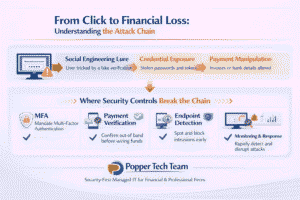
from click to finance loss

This is why, from a hacker’s seat in a neighboring time zone, a Midwestern manufacturer or a regional law firm looks just as lucrative as a global enterprise, but easier to breach. 

Inside the psychology of social engineering 

Social Engineering, the craft of manipulating human behavior, is at the heart of every successful cyberattack. The best hackers are amateur psychologists. 

Tactics like fake CAPTCHAs exploit something called “verification fatigue.” In everyday digital life, employees constantly see prompts to confirm identity: MFA codes, “I am not a robot” boxes, and update windows. The brain learns to comply automatically to get back to work. Hackers count on that muscle memory. 

In BEC attacks, they rely on contextual trust. When an email thread looks authentic and arrives from a familiar address, recipients rarely question a change in wire instructions. The attacker’s voice adopts the polite, routine tone of a colleague or vendor. Psychologically, that consistency is disarming. 

The lesson: you can’t fix human trust with firewalls. Only constant awareness, simulation, and training can recalibrate those reflexes. 

Why partnering with a security‑first MSP changes the equation 

Most businesses don’t have the internal staff or budget to keep up with fast‑evolving cyber tactics. That’s where a mature, security‑first managed service provider (MSP) becomes essential; not as a vendor, but as a strategic partner who thinks like both a hacker and a defender. 

Here’s what separates a truly security‑centric MSP from a traditional IT support team: 

  • Human‑centric safeguards

Instead of relying purely on technology, they anticipate human behavior. For example: 

  1. Implement browser isolation to prevent fake CAPTCHAs from launching scripts. 
  2. Restrict PowerShell and script permissions only to trusted administrators. 
  3. Use endpoint detection tools that look for clipboard or command anomalies, tiny signs of “ClickFix”‑style attacks. 
  4. Run tightly focused awareness programs that simulate phishing lures and “fake verification” prompts. 

The goal is to make secure decisions intuitive, not exceptional. 

  • Business email compromise prevention

Because most financial losses stem from compromised mailboxes, layered identity defense is vital: 

  1. Mandate multi‑factor authentication (MFA) and conditional access. 
  2. Use continuous monitoring for suspicious logins, impossible travel patterns, unfamiliar IPs, or unusual OAuth consents. 
  3. Automate detection of hidden inbox rules and forwarding instructions. 
  4. Require out‑of‑band (phone or verified system) confirmation for any banking change in vendor emails. 

These habits shrink the BEC attack surface dramatically. 

  • Ransomware and recovery resilience

If attackers do gain access, containment and recovery determine whether a business survives: 

  1. Patch vulnerabilities on schedule so criminals can’t exploit old flaws. 
  2. Apply least‑privilege identity principles, users get only the access they need. 
  3. Maintain segmented, immutable backups stored offline. 
  4. Test incident response playbooks quarterly. 

It’s not about perfection; it’s about having disciplined response muscles when chaos hits. 

  • Executive‑level context

Cybersecurity isn’t only IT’s concern; it’s business risk management. A good MSP translates technical signals into financial relevance for leadership teams: 

  1. Quarterly briefings tie threat intelligence to real business impact. 
  2. Security metrics show progress (e.g., reduced phishing click rates or MFA adoption). 
  3. Decision‑makers learn why a $50k loss isn’t hypothetical. 

When leaders see cyber risk as directly tied to cash flow, priorities shift fast. 

The hacker’s return on investment, and yours 

It’s sobering to realize how efficient cybercrime economics have become.

For an attacker: 

  1. Entry cost: a few hundred dollars for access tools. 
  2. Success odds: rising daily as AI tools make phishing more convincing. 
  3. Payout: $50,000, $100,000 per hit, equivalent to years of average income abroad. 
  4. Risk: low, with minimal enforcement or extradition threat. 

For you, the same event can mean: 

  1. Frozen payroll and lost vendor trust. 
  2. Customer data exposure and regulatory fines. 
  3. Reputation damage that outlasts the incident. 

Think You’re Too Small? That’s Exactly Why You’re a Target.

When attackers run cost‑benefit analysis, you lose, not because you’re careless, but because they’ve turned crime into a precise business model. 

Reframing security as a discipline, not a defense 

There’s a cultural shift all businesses must make. Security isn’t a one‑time purchase or bolt‑on service. It’s a discipline, woven into daily operations just like accounting accuracy or safety checks. That discipline has four cornerstones: 

  1. Identity control: Protect every digital identity with MFA, strong password policies, and continuous monitoring. 
  2. User coaching: Train employees not to fear mistakes but to report them immediately. Speed matters more than blame. 
  3. Payment verification: Make financial controls sacred, always confirm any banking changes out‑of‑band. 
  4. Aligned partners: Choose MSPs and vendors whose contracts and success metrics reward security outcomes, not just uptime. 

These aren’t glamorous steps, but they directly counter the economics that make you a target. 

Seeing the world through the attacker’s eyes 

Imagine it from the other side for a moment. You’re sitting behind a cheap laptop in a rented flat outside Moscow or Bucharest. You scroll through an underground forum listing dozens of exposed corporate logins from U.S. businesses, available for $50 each. You buy ten. Three work. One leads to an Office 365 account with access to the company’s accounts payable mailbox. 

You wait, watch email threads, and when a $62,000 invoice is ready to be paid, you send one altered message. The money moves before sunrise. You log off, transfer funds, and disappear. 

For you, that’s three or four years of income. For the business owner in Ohio, it’s a potential bankruptcy. Both sides experience the same event through completely different economic lenses. 

That’s why empathy for the attacker’s motivations helps leaders understand the risk. It’s not personal; they’re rational actors pursuing opportunity. Your job is to make that opportunity too expensive. 

The quieter revolution: when small businesses fight back 

Across the United States, more small and mid‑sized organizations are finally shifting from reactive defense to proactive discipline. Some invest in cyber insurance; others adopt continuous training and risk reporting. The best combine all three with the right MSP relationship. 

We’ve seen regional manufacturers halt ransomware mid‑execution because their EDR flagged unusual PowerShell use. We’ve seen accounting firms recover instantly from BEC attempts because they required phone verification before wiring money. 

These aren’t dramatic victories; they’re quiet wins that reshape the odds. They prove that even against a global, economically motivated threat landscape, small organizations can protect themselves with the same rigor as large ones. 

The bottom line: discipline is the ultimate deterrent 

For most cybercriminals overseas, your $50,000 or $100,000 isn’t just money; it’s freedom, independence, or status. For you, it’s payroll, trust, and survival. That imbalance defines modern cybercrime. 

The tactics, fake CAPTCHA, invoice fraud, and credential theft are easy to dismiss until they strike close to home. But understanding what drives the attacker reframes the conversation. They aren’t mystical hackers in hoodies; they’re opportunists running profit margins. 

Your defense doesn’t start with fear, it starts with structure: 

  • Verify before you pay. 
  • Educate before you click. 
  • Partner, before you need rescue. 

Because in this ecosystem, every small business that builds discipline helps tip the economics back toward security. 


Frequently Asked Questions (FAQ)

Why do hackers target small and mid, sized businesses instead of large corporations? 

Hackers target small and mid, sized businesses (SMBs) because the payoff, to, effort ratio is usually better than going after large enterprises. Big organizations tend to have dedicated security teams, layered defenses, strict change controls, and mature incident response plans. In contrast, many SMBs rely on basic antivirus, simple passwords, and informal processes, especially around payments and vendor management. At the same time, SMBs still move large sums of money, tens of thousands of dollars, in a single invoice or payroll run. From a hacker’s perspective, that means they can achieve a life‑changing payout with far less resistance and lower risk of detection. SMBs also often believe they are “too small to be noticed,” which leads to underinvestment in security and creates the exact blind spots attackers look for. 

How does a single $50,000, $100,000 cyberattack change the game for attackers? 

The financial impact of a $50,000, $100,000 attack looks completely different depending on which side you’re on. For a U.S. business, this range can represent a critical vendor payment, a portion of payroll, or a major project milestone. Losing that amount suddenly can mean cash‑flow crises, delayed salaries, missed obligations, and reputational damage with customers or suppliers. For an attacker in a lower‑income country, however, that same payout can equal three to five years of average wages in their local economy. It can fund a significantly higher standard of living, more tools, and further criminal operations. This disparity fuels the economics of cybercrime: the attacker’s potential reward is huge relative to their cost and risk, while the victim’s loss is painful and sometimes existential. It’s precisely this imbalance that makes SMBs such compelling targets. 

What is the “ClickFix” attack, and why is it so effective? 

“ClickFix” is a social engineering tactic that abuses people’s trust in routine verification prompts. Instead of exploiting a technical flaw, it exploits human behavior. A user encounters what looks like a normal CAPTCHA or “prove you’re human” screen, often styled to mimic legitimate services. The page instructs them to copy and paste a short code or run a simple command as part of the verification. Because users are conditioned to click through security prompts quickly to get back to work, many comply without thinking. That code, however, is actually a script that downloads and runs malware, typically an infostealer or remote access tool. Since the user initiates the action, traditional security tools may treat it as safe, allowing the payload to slip past defenses. Once installed, the malware quietly harvests passwords, browser sessions, and email access, giving attackers a foothold for deeper attacks like business email compromise or ransomware. 

What is business email compromise (BEC), and how does invoice fraud work in practice? 

Business email compromise is a type of fraud where attackers gain control of or convincingly impersonate a legitimate business email account, often in finance, leadership, or accounts payable. Once inside, they monitor real conversations between the company and its customers or vendors, paying special attention to ongoing invoices and payment schedules. At the right moment, just before a legitimate payment is due, the attacker slips into the thread and sends a message that looks authentic, changing the bank account or routing details. Because the email appears to come from a trusted contact and usually matches the tone, signature, and timing of past conversations, the recipient often follows the new instructions without suspicion. The money is wired directly to an account controlled by the attacker or by a money mule, and then quickly moved or laundered through other channels. This kind of fraud can drain tens or hundreds of thousands of dollars in minutes, with little technical trace beyond an email that looked “normal” at the time. 

How do ClickFix and BEC attacks connect in a real, world scenario? 

In many real incidents, ClickFix and BEC are not isolated events but stages in a single attack chain. It often starts with a ClickFix, style lure: an employee sees a fake verification page and follows instructions to run a “verification code,” unintentionally installing malware. That malware steals login credentials and active session tokens, which the attacker uses to log into the victim’s email account, often unnoticed. Once inside the mailbox, the attacker sets up forwarding rules, hides certain messages, or silently observes ongoing conversations, especially those involving invoices, contracts, or payment details. Over days or weeks, they gather context, who pays whom, how much, and on what schedule. Then, at a strategic moment, the attacker intervenes in an active thread, sending updated payment instructions from the compromised account. The funds are diverted, and by the time anyone realizes something is wrong, the money has been transferred again and is difficult to recover. If the attacker wants even more leverage, they may use the same access to exfiltrate sensitive data or set up a future ransomware attack. 

Why are U.S. businesses particularly attractive targets for these kinds of attacks? 

U.S. businesses sit at the intersection of several factors that make them appealing targets. Financially, even small American companies often handle large transaction amounts, making each successful attack highly profitable. Operationally, many U.S. organizations prioritize speed and convenience, fast payments, trust, based relationships with vendors, and a bias toward efficiency over friction. This can mean fewer checks when bank details change or when invoices look slightly different. Structurally, U.S. businesses also tend to have complex vendor ecosystems with many third parties, contractors, and service providers, which increases the volume of email, based transactions and opportunities for attackers to insert themselves. Finally, there is a persistent perception problem: many leaders still assume cybercriminals prefer big corporate targets. That belief leads to underinvestment in security controls and user training, leaving gaps in identity protection, email monitoring, and payment verification that attackers exploit with relatively little effort. 

What practical steps can businesses take to reduce the risk from these attacks? 

Businesses can significantly lower their risk by focusing on a few high-impact, practical measures. First, strengthen identity security by enforcing multi-factor authentication on all critical accounts, including email and remote access, and using conditional access policies to flag or block unusual logins. Second, harden endpoints and admin tools: restrict the use of PowerShell and other scripting tools to administrators, and deploy endpoint detection that looks for suspicious clipboard use, command execution, or new scripts, patterns often associated with ClickFix, style attacks. Third, implement strict payment and banking change procedures: any request to change account details for vendor payments should be verified through a separate channel, such as a phone call to a known contact, not just an email reply. Fourth, educate staff with targeted training, not generic lectures, simulate fake verification prompts, invoice scams, and mailbox rule alerts so employees recognize and report them quickly. Finally, maintain tested backups that are segmented and tamper-resistant, and have a clear incident response plan so the team knows exactly what to do when something goes wrong. 

How does working with a security-first managed service provider (MSP) help? 

A security, first MSP brings structure, expertise, and continuous attention that most SMBs can’t maintain internally. Instead of just “keeping the lights on,” a good MSP designs your environment to resist the specific tactics attackers use, such as ClickFix, BEC, and ransomware. They help implement and enforce multi-factor authentication, conditional access, endpoint protection, logging, and inbox rule monitoring. Beyond technology, they create and maintain incident response runbooks so everyone knows who does what when an incident is detected. They also run tabletop exercises and live simulations, like fake verification drills and mock invoice fraud scenarios, to test your people and processes under realistic conditions. In the event of a real attack, a security-focused MSP can coordinate rapid containment steps, assist with communication, and help liaise with banks or law enforcement to improve the chances of freezing or recovering funds. Over time, they provide regular risk briefings to leadership, translating technical threats into business language, which helps decision‑makers justify and prioritize ongoing security investments. 

Blog, February 2026 Blogs

The Productivity Payoff: What You Gain When AI Is Done Right

You know the feeling. Your team is working hard, but hours are burned without much impact. Manual tasks eat into time that could be spent driving revenue and growth. For many small and medium-sized businesses, this is the daily grind.

Now imagine a different picture: processes run smoothly, customer requests get handled faster and your team spends more time on strategy and less on repetitive work. That’s what happens when artificial intelligence (AI) is implemented correctly. Done wrong, it adds to the complexity. Done right, it becomes a tool that makes your business sharper, faster and more competitive.

So, what does “done right” look like? Let’s break it down.

Where AI delivers real value

AI isn’t just a buzzword; it’s a practical way to improve your business operations. When implemented strategically, AI integrates with existing systems and has clear use cases that are tied to business goals.

Here’s how it creates impact where it matters most:

Faster service delivery
Every hour spent on scheduling, ticket routing and data entry is an hour lost on growth. These tasks don’t move the needle, but they consume valuable time. Automating them means your team can respond to customers and complete internal processes faster without adding headcount.

Imagine cutting response times by 30% and freeing up your staff to focus on revenue-generating activities. That’s the power of AI done right.

We help identify where automation makes sense and then integrate AI tools into your existing systems without causing disruption.

Fewer errors, more accuracy
Mistakes happen when people are burned out or juggling too many tasks. AI reduces errors in data handling, reporting and customer interactions. Predictive tools spot issues before they occur, such as inventory shortages or missed deadlines.

Think about the savings: fewer errors mean fewer costly mistakes and happier customers. We configure and monitor AI systems to keep them accurate and reliable.

Better customer response times
Customers expect quick answers. AI-powered chatbots and virtual assistants provide instant support, even outside of business hours. AI can also prioritize and route inquiries, so the right person handles them promptly.

Imagine your customer service team handling twice as many inquiries without burning out or hiring more staff. We deploy and manage these tools securely, ensuring they enhance your service without losing the human touch.

Time freed for strategic work
When AI handles routine tasks, your team can focus on growth initiatives, innovation and building stronger customer relationships. Instead of firefighting, you’re planning ahead.

We help you shift from reactive problem-solving to proactive strategy by optimizing your technology so everything works together seamlessly.

Ongoing monitoring and continuous optimization
AI isn’t a set-it-and-forget-it solution. It requires ongoing monitoring and adjustments to keep delivering value. Many small and medium-sized businesses lack the resources for that level of oversight.

That’s where our team comes in. We provide updates, performance reviews and ongoing support so your AI tools continue to deliver results.

Ready to see the payoff?

AI isn’t about replacing people; it’s about unlocking your team’s full potential. The businesses that embrace AI now are the ones setting the pace for their industries. Don’t let your competitors outpace you.

With the right strategy and a trusted partner, AI becomes more than a tool — it becomes your competitive edge. We’ll help you implement solutions that fit your business, deliver measurable results and keep improving over time.

Take the first step today. Schedule a 15-minute consultation and discover how AI can transform your operations, boost productivity and drive real growth.

Blog, February 2026 Blogs

How AI Can Help Businesses Scale Without Adding Complexity

Growth should feel exciting, not overwhelming. But for many business leaders, scaling means juggling more customers, more tasks and more moving parts. The result? Teams spend more time chasing updates than driving real progress.

This is where artificial intelligence (AI) changes the game. When implemented correctly, AI reduces routine tasks, supports faster decision-making and streamlines operations, allowing you to scale efficiently without chaos.

In this blog, we’ll explore why businesses feel the strain as they grow, how AI eases the load, where it makes the biggest impact and how the right partner keeps AI simple and effective.

The growth challenge for businesses

Picture this: Your business enters a new phase of growth. You attract more customers, your workload increases and your team pushes hard to keep everything moving. At first, it feels manageable. Then the cracks appear.

A customer needs a quick update, but no one knows who handled it previously. Another employee spends hours piecing together information from old email threads. Meanwhile, someone else has to step away from their actual role to onboard a new hire.

None of this feels critical at first. But over time, key information becomes scattered everywhere, work depends on memory and the more you try to organize it, the more complicated things become.

AI as a force multiplier

AI isn’t here to replace your team; it’s here to empower them. By taking on repetitive tasks and organizing information, AI frees your team to focus on the work that drives growth.

Here’s how AI helps you scale without adding complexity:

It takes over repetitive tasks: With AI, you can automate everyday tasks that waste time, allowing your team to focus on work that brings more value to customers.

It keeps information organized and accessible: When your business grows, information spreads across inboxes, chats and shared drives. AI can help you pull that information together into one accessible place.

It helps you respond at the pace customers expect: AI enables your team to respond faster with more accurate information, building trust and reducing back-and-forth.

It supports growth without adding more tools: AI scales alongside your business, helping you deliver more without piling on new tools or manual processes.

Practical AI use cases you can start with

Here are some simple ways you can put AI to work in your business without adding new systems or complexity:

Customer service
Deploy AI chatbots or smart FAQ systems to answer routine queries. They can also summarize lengthy conversations for your team, allowing them to respond quickly.

Sales and marketing
With the help of AI tools, you can qualify leads, draft emails and keep follow-ups on track, freeing your team for more revenue-driving work.

Operations
AI tools can help you refine your workflows, identify delays, schedule tasks and forecast needs, reducing bottlenecks and improving productivity.

Why simplicity matters

Most business leaders don’t have the time to deal with complex technology with dozens of confusing features. AI delivers value only when people can use it effectively. But for that to happen, AI must feel simple and align with your everyday work.

AI initiatives often struggle when new tools don’t work with existing systems or workflows become so complex that only a few people understand them.

Our role in keeping it simple

AI should make your work easier without adding confusion. That’s where we come in.

We work with you to identify the right problems to solve, integrate AI into existing workflows seamlessly and set clear expectations for how it’s leveraged. We remove the friction.

By keeping things simple, we help you build an AI foundation that you can adjust and scale in a way that feels manageable. No rushed rollouts. No unnecessary features. Just steady improvements that support your growth.

Ready to scale smarter? Don’t let complexity slow your success. Book your AI-readiness consultation today and start building a growth strategy that’s simple, sustainable and effective.

Blog, February 2026 Blogs

The Hidden Risks of DIY AI: What Businesses Miss Without an IT Partner

AI promises big wins, but without the right approach, it can backfire.

Efficiency, time savings and innovation are what every business leader wants from an artificial intelligence (AI) solution. And yes, the opportunity is real. AI is reshaping how businesses operate at every level. But here’s the catch: AI isn’t a plug-and-play tool. It’s more like hiring a new team member who needs clear goals, quality data and strong security rules.

Skip those steps and what feels like a quick win can turn into a costly mess of misconfigurations, security gaps and underperforming tech. That’s why going DIY with AI is riskier than most businesses realize.

Why it’s hard to do alone

AI has tremendous potential, but making it work alongside existing systems, customers and workflows is where many businesses struggle. Without governance, security and alignment, AI can quickly become a liability instead of an advantage. Here are some reasons why DIY approaches often fall short:

Misaligned AI implementation: Treating AI like any other software is a common mistake. A team member tries a new tool, runs a few prompts and suddenly it’s part of your workflow. Everything feels smooth and easy in the beginning, until outputs don’t align with your goals. Now your team spends hours reworking AI-generated content, customers are unhappy and your AI tool is yet another disconnected system.

How an IT partner helps: We align AI solutions with your business objectives and existing systems. From strategic planning to seamless integration, we make AI predictable and useful, so you see real value, not chaos.

Security vulnerabilities: DIY AI setups often overlook security, putting your business data and customer information at risk. Your employees may unknowingly share sensitive information into public tools, while plugins and extensions quietly connect to your systems without proper safeguards. One simple mistake can damage your reputation and customer trust.

How an IT partner helps: We secure your AI tools and solutions from day one. Our experts know how to set up proper data protection, apply access controls and monitor activity. Plus, we help train your team to understand what information can and cannot be put into AI tools. This reduces your risk and protects your business.

Wasted investment: It’s easy to fall for trending solutions that may not deliver the results you need. Without a clear strategy, you end up paying for solutions you don’t need or can’t use effectively. Once the excitement fades, your investment feels like a costly experiment.

How an IT partner helps: We help you choose tools that align with your business goals. After setting up your AI systems, we continuously track results so you always know what’s working. This makes it easy to see how your investments are moving your business forward.

Lack of scalability: If you want to grow your business to new heights, your tools must keep pace with growth. A DIY AI setup might work on a small scale, but as your business grows, it is likely to crumble under pressure. Without scalable solutions, you’re stuck juggling temporary fixes instead of focusing on growth.

How an IT partner helps: We know that growth requires stability, not shortcuts. From workflows to security controls, we design AI systems for stability and scalability so your technology supports your success instead of slowing it down.

Start your AI journey with confidence

AI isn’t a passing trend; it’s a permanent part of the new business landscape. That’s why getting your AI journey right from the very beginning matters. While a DIY approach might seem like a way to save money, it often leads to costly mistakes and missed opportunities.

With us as your trusted partner, you gain expert guidance, proven strategies and the confidence that comes from knowing your AI investments are secure, scalable and delivering results.

Don’t wait until missteps cost you time, money and customer trust. Book your AI-readiness consultation today and take the first step toward smarter, safer growth. Your competitors aren’t waiting. Why should you?

Blog, February 2026 Blogs

AI-Powered Cyberthreats: What You Need to Know (And How We Can Help)

AI is helping supercharge cybercrime and today’s businesses are in the crosshairs. Attacks are faster, smarter and harder to spot. For many small-to medium-sized businesses (SMBs), the question isn’t if an attack will happen, but when.

Cybercriminals are using artificial intelligence (AI) to create scams that look real, sound real and move at lightning speed. From fake CEO voices to cloned websites, these attacks are designed to fool even the most cautious business owners — and the consequences can be devastating. One successful breach can drain your finances, damage customer trust and halt operations.

The new threat landscape

AI has transformed cybercrime, making attacks more convincing and harder to detect. Here’s what you need to know about the tactics criminals are using right now:

Phishing that looks perfect
Phishing emails used to be easy to spot. Bad grammar, odd phrasing and strange links gave them away. Not anymore. AI crafts flawless emails that mimic your team’s tone and branding. Attackers can even clone your website to trick customers and partners into sharing sensitive information.

Deepfakes that fool your team
Imagine wiring $50,000 because you got a call that sounded exactly like your CEO. AI-generated voices and videos make these scams frighteningly real. Deepfake technology is taking social engineering to the next level, exploiting trust and bypassing traditional safeguards.

Ransomware that anyone can launch
You no longer need to be a hacker to launch ransomware. AI-driven platforms let anyone rent attack tools and target businesses like yours. These tools have lowered the barrier to entry, resulting in more frequent and increasingly sophisticated attacks, even from less-experienced threat actors.

These threats aren’t just clever tricks. They’re designed to bypass traditional defenses. Firewalls and antivirus software alone are no longer enough. Criminals are using AI to stay ahead and they’re doing it at scale.

Why SMBs are prime targets

Cybercriminals know where to strike. They’re looking for businesses that are easier to breach and SMBs fit the profile. Here’s why:

  • Smaller budgets and lean IT teams make you an easy entry point
  • Most SMBs lack AI-specific security policies or response plans
  • AI-powered attacks move fast and look real, making them especially tough to detect

Hope isn’t a security strategy. AI-driven threats move faster than your current defenses. It’s time to upgrade before it’s too late.

How we help

You don’t have to fight this alone. We make AI your advantage, not your risk. Because AI is not the enemy, misuse is. We provide proactive defense to help protect your business:

Secure AI adoption
We help you integrate AI tools safely into your workflows so you can innovate without compromising security.

Threat monitoring
Our team provides continuous oversight to catch and neutralize AI-driven threats before they cause damage.

Policy and training
We build AI usage policies and train your staff to spot warning signs. Awareness is your first line of defense.

Vendor vetting
We review third-party AI tools for security and compliance before you use them, so your partners don’t become your weakest link.

Don’t wait until it’s too late

Every day you wait is a day attackers get smarter. Let’s secure your business now, before they strike. Book a consultation today and take the first step toward AI-powered protection.

Blog, January 2026 Blogs

How Digital Transformation Helps Your Business Work Smarter and Grow Faster


Big technology isn’t just for big businesses anymore. The tools that once gave large enterprises an edge are now within reach for organizations of all sizes. Today, even small businesses can harness the same powerful technologies to automate repetitive tasks, boost team collaboration and stay connected with customers like never before.

Digital transformation helps you shift away from working harder to “working smarter.” By embracing modern tech, you can simplify daily operations, speed up processes and build a more reliable foundation for growth without adding extra hours to your day.

What does working smarter mean for business leaders?

As a business leader, you’re always at the helm, making decisions that shape the future of your organization. However, if you are too caught up in everyday tasks, it can become difficult for you to find time to think strategically.

That’s where technology helps you work smarter. Digital transformation isn’t about adding more to your plate. It’s about clearing space so you can step back and focus on work. Here’s what working smarter looks like:

Time freed up from repetitive tasks

Most businesses spend hours each week on things like data entry, scheduling and follow-ups. Automating these tasks gives you back time to focus on customer service, creativity and growth.

Fewer errors and improved accuracy

Mistakes are inevitable when processes depend too much on manual steps. Automation can help you cut down on double-entry and the costly errors that come with it.

Better decision making with real-time insights

Instead of relying on gut feelings, you can now base your decisions on up-to-date information. Whether it’s sales trends, project progress or customer satisfaction, you know what’s happening, and you can make informed decisions based on facts.

Business benefits of digital transformation

Digital transformation helps you clear the roadblocks that slow your business down. It connects your people, processes and data so you can run your operations more efficiently. Here’s how digital transformation benefits your business:

Work more efficiently: If your team spends endless hours looking for files or repeating the same steps, your business is ultimately going to suffer. Digital tools make it easier to share updates, stay organized and get things done right the first time.

Make smarter decisions, faster: Real-time information transforms how you lead. When you can see what’s happening and understand why, you can confidently make decisions that push your business forward.

Improve customer experience: Customers remember when you make things easy for them. By being able to respond quickly with some personalization, you can turn a one-time buyer into a loyal client.

Grow without growing pains: Growth should feel like progress, not pressure. With scalable digital systems, you can expand without disrupting everything.

Stay competitive: Successful businesses know the pulse of the market and they’re able to pivot with the changes. With the help of modern tools, you can seize new opportunities and stay ahead of the competition.

Reduce costs over time: Inefficiencies quietly drain your profits. By streamlining workflows and automating repetitive steps, you can reduce waste, prevent errors and save money across the board.

Boost team productivity and morale: Teams that feel empowered deliver better results. If your tech tools efficiently support your team instead of slowing them down, they’ll feel more motivated to do their best.

How we make it easier

Every business is unique. That’s why digital transformation doesn’t have a one-size-fits-all approach. We take the time to understand your goals, your challenges and the way your team works, and then we recommend the right tools to match.

From setup to ongoing support, we make sure every solution fits your team and grows with you. While you focus on running your business, we keep your systems secure and up to date.

Digital transformation isn’t about being tech-savvy; it’s about working smarter. Ready to make tech work for your business? Schedule your discovery call today.

Scroll to Top