
The OG of IT - Joe Popper

Author name: The OG of IT - Joe Popper

Blog, May 2026 Blogs

Are You Getting Full Value From Your Tools?

Here’s a scenario most business owners will recognize: You’re paying for software your team uses every day. Nobody’s complaining about it and things are generally getting done. So, you leave it alone and focus on everything else that needs your attention.

That’s a completely reasonable call. But using a tool isn’t the same as fully leveraging it, and that distinction is one of the most common reasons businesses don’t get full value from their tools.

When software gets deployed, most users learn just enough to get their work done and move on. Many features that could improve productivity stay untouched. A year later, when the subscription renews, minimal usage is standard, and nobody flags it because it’s working.

Midyear is the time to ask a harder question: Are your tools working for your business, or is your business working around your tools?

Why ‘full value’ matters

Most people measure a tool by whether it runs and people use it. That’s a low bar. A tool can pass both tests and still cost more than it’s giving back.

Full value doesn’t mean:

  • The software runs without errors
  • People log in regularly
  • Tasks get completed

Full value looks like:

  • Your team uses the features that save time, not just the basics they learned on day one
  • Manual work is significantly reduced, not shifted to a spreadsheet sitting beside the platform
  • The tool fits how your business operates today, not how it operated when the tool was first set up
  • You’re not paying for a second platform that does the same job
  • The system makes work simpler and faster, not something people have to manage on top of their jobs

Full value shows up in time saved, money not wasted and smoother day-to-day work. If you can’t point to those outcomes, there’s a gap worth looking at.

4 areas businesses commonly lose value

The gap between how you use your tools and what they’re capable of usually doesn’t come from one obvious mistake. It tends to build slowly across a few common areas.

  1. Underused features

Like we mentioned earlier, when a tool is introduced, the team usually learns what they need to get their work done. After that, usage settles into a routine. Core features get used consistently, but the broader capabilities often remain untouched.

That can include:

  • Automation that could reduce repetitive work but was never configured
  • Built-in reporting that wasn’t fully set up
  • Integrations between systems that were available but never activated
  • Advanced features included in the license that no one had time to explore

Over time, basic usage becomes the norm, even if the tool was designed to support much more.

  1. Overlapping tools

As your organization grows, purchasing decisions may be decentralized. While each tool may make sense on its own, without coordination, overlap can develop.

You might see:

  • Two platforms handling similar workflows
  • Different teams storing related information in separate systems
  • Communication spread across more tools than necessary

No one intends to duplicate effort, but the list of tools expands gradually and the overall value becomes harder to track.

  1. Manual workarounds

Workarounds usually develop when a tool hasn’t been fully configured or no longer matches the way your team works. At first, these adjustments seem minor.

Common patterns include:

  • Exporting data into spreadsheets to complete tasks the platform could handle
  • Managing approvals through email instead of using built-in workflows
  • Entering the same information into multiple systems because they aren’t connected

Over time, those workarounds become embedded in the process, and the original purpose of the tool becomes less clear.

  1. License and subscription drift

Subscriptions often renew automatically, which means they continue unless someone actively reviews them. In busy organizations, that review doesn’t always happen.

That can lead to:

  • Paying for licenses assigned to former employees
  • Staying on higher tiers that aren’t fully used
  • Continuing subscriptions that no longer align with business needs

Individually, these small inefficiencies don’t stand out. Collectively, the cost can significantly impact the bottom line without you noticing.

Technology reviews usually happen only when something breaks. As long as the tool works, there’s no trigger to reassess it. IT becomes reactive support instead of a periodic checkpoint. The question of whether your tools are still earning their place simply doesn’t come up.

What a technology performance review does

A technology performance review is a structured look at what you already own and whether it’s doing the job you’re paying for. It’s not a pitch for new software or an excuse to overhaul your systems. It’s a practical evaluation of where your existing tools are working well and where they’re costing you more than they should.

A review should look at:

  • What tools you have, who’s using them and how much they’re being used
  • Whether your platforms match how your business operates day to day
  • Where you may be paying for redundant systems doing the same job
  • Where manual workarounds have replaced functionality that you already pay for
  • What you’re spending across your software environment and what you’re getting in return

The outcome isn’t a list of things to replace. It’s a clear view of where your current systems can deliver more value, along with practical steps your team can take without major disruption.

What changes when your tools are working for you

When your systems are set up properly and used as intended, the difference shows up in day-to-day operations.

  • Your team gets more done without adding headcount
  • Your software budget reflects tools that are actively being used
  • Work moves faster because unnecessary friction has been removed
  • Your workforce spends less time on workarounds
  • As the business grows, operations don’t become harder to manage

Before allocating budget to something new, confirm you’re getting full value from what you already have. In many cases, that’s the more efficient and lower-risk path.

Now is a good time to find out where you stand

If you haven’t reviewed how your tools are being used this year, there’s a reasonable chance you’re paying for more than you’re getting.

A technology performance review gives you a clear view of whether your systems are delivering what your business needs today. If you’d like to explore whether it makes sense for your business, start with a short discovery call. This straightforward conversation will review what you’re using now and where value may be slipping.


Blog, May 2026 Blogs

Don’t Automate Chaos: Preparing Your Systems for AI

AI is everywhere right now, and the pressure to do something with it is real. The question most business leaders are asking is whether they should be using it. But the more critical question is whether their business is ready for it.

AI works best in an already organized business. It doesn’t fix broken systems or unclear processes. It runs on whatever foundation is already in place, and if that foundation has cracks, AI will find them faster than you can.

Before deciding where AI fits, it’s important to understand what it does best, where it tends to go wrong and what needs to be in place for it to work.

What AI can and can’t do

Used well, AI helps businesses move faster with the resources they already have. It handles repetitive tasks, drafts communications, detects patterns in data and reduces the manual hand-offs that slow work down. For small businesses in particular, those gains add up quickly because the time savings go straight back to the people doing the work.

What AI can’t do is fix a disorganized business. It doesn’t know what matters most to your organization. It doesn’t understand your context the way your employees do. And it doesn’t set its own agenda. It works within the structure you already have, for better or worse.

AI amplifies your systems. It doesn’t organize them.

What happens when you automate chaos

When AI is layered onto a business that isn’t operationally ready, the damage doesn’t show up as a big, obvious failure. It shows up as performance quietly getting worse. The problems that existed before don’t go away. They just move quicker and become harder to trace back to their source.

In practice, it tends to look like this:

  • AI pulling from inconsistent or duplicate data and producing outputs that nobody fully trusts
  • AI tools added to a platform stack that already has too much overlap between systems
  • Employees independently adopting AI tools with no shared standard for how they’re used, a problem sometimes called shadow AI
  • Sensitive business information flowing through AI systems without clear rules about what’s allowed

The knock-on effects are predictable: more complexity, conflicting versions of the truth, friction in workflows, security exposure and a growing list of subscriptions nobody is fully on top of.

These are distractions, not disasters. But distractions running at the speed of automation are expensive.

Signs that your business isn't ready to layer in AI

Readiness for AI isn’t about the size of your business or how much budget you have. It’s about whether your current systems and workflows are organized enough to support automation without making your existing gaps bigger.

Consider slowing down if:

  • You haven’t fully reviewed your tool stack in over a year
  • Employees regularly use spreadsheets outside your primary systems to get their work done
  • Multiple platforms in your business handle similar functions without a clear reason why
  • Access permissions and user roles haven’t been looked at recently
  • You’re not sure which features of your current tools are being used
  • Manual workarounds have become common enough that they’ve quietly turned into the official process

If your systems aren’t aligned, AI will accelerate the inefficiencies.

What getting ready for AI looks like

Preparing for AI doesn’t mean a lengthy technology project or a big upfront cost. It means taking an honest look at how your current systems are set up and making sure the foundation is solid.

In practical terms, that means:

  • Mapping your core workflows so you know where automation could genuinely reduce work
  • Making sure your tools reflect how your business operates now, not two years ago
  • Removing redundant systems that create overlap and make it harder to know where information lives
  • Cleaning up user permissions and access controls so the right people have access to the right things
  • Organizing your data so AI has something reliable and consistent to work with
  • Reviewing features in your current platforms that haven’t been set up or used yet

AI performs best in organized environments. Businesses that get the most out of AI have their foundation in order before they start.

A smarter approach to AI adoption

Properly adopting AI means not hurriedly implementing the latest features before you’ve thought through what problem you’re solving. The businesses that handle this well tend to approach it like any other significant operational decision: deliberately and with a clear picture of where they stand first.

A structured approach starts with:

  • Taking stock of your current systems to understand what’s working and what isn’t
  • Identifying the specific areas where AI can create real, measurable value
  • Understanding where adding AI might create more complexity than it solves
  • Making sure security and data governance are set up properly before any automation goes live

A technology performance review is a natural starting point for all of this. It’s not a commitment to a major rollout or a reason to overhaul everything. It’s a readiness check that tells you where your systems are aligned, where they aren’t and what needs to be sorted before AI can do what it’s supposed to do.

No forced upgrades. No hype-driven rollout. Just a clear look at where you stand and what makes sense as a next step.

What it looks like when you get things right

When AI is introduced into a business with solid systems and well-defined workflows, the results are real and sustainable rather than short-lived.

  • Productivity gains are genuine because the automation is working with clean, consistent inputs.
  • Repetitive work gets reduced without creating new confusion about who owns what.
  • Data insights can be trusted because the underlying information is organized and up to date.
  • Risk stays manageable because governance was built into the process from the beginning.
  • Growth becomes easier to handle because the foundation underneath it is strong enough to support it.

The smartest AI strategy isn’t about moving fast; it’s about building a strong foundation.

Build the foundation before you build on top of it

AI can make a real difference in how your business runs, but it works best when it’s enhancing something that’s already functioning well, not filling in for structure that was never there.

The businesses that benefit most from AI are the ones that take the time to get their systems right first.

That’s not a reason to wait forever. It’s a reason to start by taking a clear-eyed look at where your systems stand.

Schedule a technology performance review to assess your AI readiness and strengthen your operational foundation before you start building on top of it.

Blog, May 2026 Blogs

Is Your Security Built Into Your Operations or Added On Later?

Security rarely fails loudly. More often, it slips out of alignment over time, with small gaps building quietly in the background while the business keeps moving forward.

Take Marcus. He’s a fictional business owner, but his situation is one many businesses will recognize. Eleven years in, his company was running well. Antivirus, two-factor authentication and backups were all in place. Nothing had ever gone seriously wrong, and over time, that started to feel like proof that everything was as it should be.

Then he asked a simple question: “Who currently has access to our main systems?”

It took three days to get a clear answer. And when it finally came, it pointed to a collection of small inconsistencies that had built up over time, none of which had been visible day to day.

There were gaps in access, overlapping tools and permissions that had expanded without clear structure.

Nothing had gone wrong. But nothing was quite right either.

The question isn’t whether you have security tools in place. It’s whether security is built into how your business operates.

What ‘added-on’ security looks like

Marcus’s situation is a good example of what security looks like when it grows in pieces instead of being built into daily operations.

None of the issues came from a major mistake. They came from small decisions made over time, the same kind most businesses make while trying to keep work moving.

Different systems ended up with different access rules. A former employee’s account was still active months after leaving. Two departments were paying for tools that did the same job without realizing it. Several employees had admin-level permissions that were granted quickly and never reviewed.

Individually, none of these situations felt urgent. Nothing appeared broken and the business continued running as usual.

But small gaps have a way of accumulating. More often, they develop gradually through small misalignments that are never revisited.

What built-in security looks like

Marcus didn’t flip a switch and transform his business overnight. What he did was build a framework that made security part of how his business operated, not just something added after the fact.

That’s the difference between patchwork and strategy. Built-in security means access is role-based and reviewed regularly, systems are consolidated to reduce blind spots, purchases and renewals go through central evaluation, and onboarding and offboarding are standardized so nothing slips through.

In practical terms, it looks like this:

  • Access is tied to roles rather than individuals, so when responsibilities change or someone leaves, updates are straightforward and consistent.
  • Systems are reviewed and consolidated to reduce overlap, limit blind spots and give the business a clearer view of what it’s using.
  • Software purchases are evaluated centrally, which helps keep the tool count manageable and the overall approach consistent.
  • Renewals aren’t based on cost alone. They also include a review of whether the tool still fits the business and whether access is still appropriate.
  • Onboarding and offboarding follow a standard process every time, so less gets missed when someone joins, changes roles or leaves.
  • Most importantly, there’s visibility. Someone in the business can answer the question Marcus once couldn’t: Who has access to what and why?

None of this requires deep technical knowledge, but it does require the same kind of deliberate thinking that goes into running any other part of the business well.

When systems are aligned and access is managed with intention, security doesn’t have to be bolted on after the fact. It becomes stronger by design.

Where a technology performance review fits

Once Marcus understood how things had fallen behind, the next question was a simple one: What do we do about it?

He didn’t need someone to tell him everything was broken. He needed a structured way to look at what had built up over 11 years, understand where things had slipped and put a framework in place that would hold up as the business kept growing.

A technology performance review is exactly that. It isn’t a crisis response, and it isn’t a process that ends with a long list of forced replacements or disruption to how the business runs. It’s a structured, methodical evaluation of whether the technology and access controls in place still reflect how the business operates today.

A review looks at:

  • Whether access controls are consistent and aligned with current roles
  • How permissions are granted and whether they’re regularly reviewed
  • Where tools overlap or create redundancy
  • Whether shadow IT is creeping in unnoticed
  • How onboarding and offboarding processes are being handled
  • The level of visibility into who has access to what across the business

The goal isn’t to force replacements or interrupt daily operations. It’s to provide clarity. A structured evaluation that highlights what’s working, where gaps exist and how refinement can strengthen security without drama.

Align your operations and security today

In a scenario like Marcus’s, the story doesn’t have to end with a crisis. It can end with clarity. For most real businesses that take this step, that’s exactly how it goes.

Security isn’t something to revisit only after something goes wrong. It works best when it’s built into how your business is structured and reviewed on a regular basis.

If your security has been built up incrementally over the years, you’re not alone. But there’s a difference between having measures in place and having security that’s genuinely aligned with how your business operates today.

Take the first step toward stronger, built-in security. Contact us to schedule your technology performance review today. Let’s make sure your security is aligned with your operations, not layered on after the fact.

Blog, May 2026 Blogs

How to Build Your Technology Foundation to Support Growth

Business growth is a good problem to have until it starts making things harder.

What used to be fast and easy now takes extra steps. A report takes longer. A task lives in two places. A quick decision turns into back-and-forth that eats up half of your afternoon. Individually, each of these is manageable. Together, they slow everything down.

Complexity creep is the part of business growth no one talks about, and it leaves your team spending more time navigating work than being productive.

Your technology foundation is more important than ever, and it’s under pressure to keep up.

What a strong technology foundation looks like

Think about a week when everything just ran smoothly.

Your team knew where to find what they needed without sending a message asking, “Which folder is that in?” A new client came on board and setting them up took hours, not days. You weren’t paying for three tools that all did nearly the same job while everyone quietly guessed which one was the main one. Most of all, nothing important fell through the cracks because there was a clear process to catch it.

That’s the byproduct of a strong, well-maintained technology foundation.

When your tools work well together, your team stops working around the system and starts moving with it. Processes are clear and work flows without getting lost, delayed or overlooked. It’s easy to spot something that needs attention.

When your IT foundation is in good shape, growth feels manageable instead of chaotic because your business is prepared to handle challenges when they surface.

Why foundations weaken over time

Foundations don’t weaken overnight. They weaken gradually, through a series of reasonable decisions that made sense at the time, such as:

Adding tools as new needs come up

One team picks a tool to solve a problem. Later, another team chooses something similar without realizing there’s already a solution in place.

Letting quick fixes stay in place for too long

A spreadsheet meant to be temporary becomes part of the daily routine. A workaround that helped in the moment quietly becomes standard practice.

Getting used to extra steps

People start copying information from one place to another, keeping side notes or relying on their own trackers because the main IT setup feels too hard to trust.

Not revisiting access as roles change

Someone gets the access they need to do their job, but those permissions aren’t always revoked when their role changes or when they leave the business.

Allowing subscriptions to keep renewing without review

Tools stay in place simply because no one has the time to stop and ask whether they’re still needed.

None of these things feel urgent on their own. That’s exactly why they’re easy to miss. But over time, they add friction, reduce visibility and make the foundation harder for your business to rely on.

6 steps to strengthen your foundation

If the previous section felt familiar, here’s the good news: Fixing it doesn’t mean starting over.

In most cases, improvement comes from using what you already have more effectively. This is refinement, not disruption.

Here’s where to start.

  1. Review the tools you’re using: Look at which tools your team relies on day to day and which ones are no longer needed.
  2. Remove overlap: If different tools are doing the same job, simplify where it makes sense. For example, one team may be using one tool to track projects while another uses something else for nearly the same purpose.
  3. Simplify workflows: Look for extra steps, delays and workarounds that make everyday tasks harder than they need to be. For example, if someone has to copy the same information into two places just to keep work moving, that’s usually a sign the process needs to be simplified.
  4. Clean up access: Review who has access to what and remove anything that no longer fits the person’s role.
  5. Clarify ownership: Make sure every tool has a clear owner. If something stops working properly or needs updating, it should be clear who handles it.
  6. Standardize key processes: Important tasks should be handled in a clear and consistent way across the business. For example, bringing on a new employee or setting up a new client shouldn’t depend on who happens to be doing it that day.

The goal isn’t perfection. It’s alignment. Most gains come from making better use of what you already have, not adding more.

How your business benefits when you get this right

Reviewing, simplifying and standardizing your technology doesn’t just reduce complexity; it makes your entire business run better.

Here’s what a stronger foundation looks like in practice:

Fewer bottlenecks

When tools work well together and processes are clear, work moves with fewer delays. People spend less time waiting, chasing information or working around problems.

Faster execution

Your team spends less time figuring out how to get things done and more time doing the work. Bringing on a new client, onboarding a new employee or launching something new becomes easier to manage.

Less wasted spend

Unused subscriptions, overlapping tools and duplicate platforms can quietly drain budget. A stronger foundation helps make sure your spending is supporting the business in a clear and useful way.

Increased employee productivity

People do better work when the tools and processes around them make sense. When the day feels less frustrating, it’s easier for teams to stay focused and move work forward.

Reduced security risk

When access is reviewed, offboarding is handled properly and there’s a clear view of who has access to what there are fewer gaps for problems to slip through.

Clearer visibility into operations

When your business IT is set up clearly, it’s easier to see what needs attention and where things may be slowing down. That helps you make better decisions.

Is your foundation ready for what’s next?

Some businesses handle growth with confidence. Others feel the strain.

The difference usually isn’t talent, effort or ambition. It’s what’s underneath. Businesses that grow well are the ones that have taken the time to make sure the foundation supporting their business can carry what comes next.

They don’t wait for something to break before they pay attention. They review, refine and strengthen on a regular basis. That’s what helps growth feel like an opportunity instead of a constant source of pressure.

If you haven’t taken a close look at whether your technology foundation is ready to support your next stage of growth, now’s a good time.

We work with businesses to review what’s already in place, identify where things may have fallen behind and build a practical plan to strengthen what’s there without unnecessary disruption. No hard sell. No major overhaul. Just a clear picture of where you stand and a straightforward path forward.

Schedule a 10-minute discovery call today and let’s talk about how to strengthen what you’ve already built.

April 2026 Blogs, Blog

The ROI of Decluttering Your Tech

You’re getting ready for a party and you want that one jacket that fits perfectly and makes you feel confident.

But when you open your closet, you can’t find it because it’s buried under too many other things. So, you do what feels easiest. You buy another jacket. It solves the immediate problem, but it doesn’t fix the root cause — the mess in your closet.

Businesses often face the same dilemma when thinking about their return on investment (ROI) in technology.

When efficiency slips or results stall, the reflex is to invest in something new, another tool, another platform, another promise of improvement. The assumption is that greater capability will naturally yield higher returns.

Over time, though, systems accumulate the way clothes do. Each purchase made sense when it was added and each one still technically gets the job done, so nothing gets removed.

From the outside, the tech setup looks strong. Inside, the experience feels heavier than it should. People spend time deciding where work belongs, simple tasks take longer than anticipated and even small fixes require more coordination than they should.

ROI isn’t always found in the next purchase. Sometimes it’s uncovered by clearing what’s in the way.

Why decluttering delivers real ROI

Technology clutter rarely causes dramatic failures. Instead, it creates small and persistent delays that are easy to overlook at first.

It shows up as extra steps, minor interruptions and low-level confusion that drains time and attention.

Decluttering changes that dynamic. A simpler, more intentional technology environment allows work to move with fewer obstacles.

People know where to go and which system to rely on. Costs become easier to track and problems surface earlier while they’re still manageable. Planning feels more grounded because there are fewer hidden dependencies.

This is where technology ROI expands beyond financials. Here are five areas where reducing complexity has measurable ROI.

ROI area #1: Time reclaimed

When tools overlap or workflows aren’t clear, people lose time in small ways. They switch between systems, double-check information and create workarounds just to get through the day.

Decluttering removes those extra steps.

When people know exactly where work happens, tasks move faster, onboarding becomes easier and projects flow more smoothly.

A few minutes saved per person each day quickly add up to hours across the business. Time reclaimed compounds.

ROI area #2: Reduced costs

Technology clutter often hides quiet expenses. Unused licenses, overlapping tools and systems that stay in place long after they’ve outlived their value.

Then there are the surprise costs that come from outdated or poorly understood systems.

Decluttering brings spending back under control. You stop paying for what you don’t need. You avoid emergency fixes. Costs become clearer and more predictable. Money stops leaking in places that no longer add value.

ROI area #3: Lower risk and fewer surprises

Complex systems create uncertainty because it isn’t always clear how one part connects to another. When dependencies aren’t clear, even small changes feel risky and problems take longer to resolve.

Simplifying the environment reduces those blind spots. With fewer overlapping systems, ownership becomes clearer and day-to-day operations feel more under control.

Predictability is one of the most overlooked returns on technology investments, yet it’s often one of the most valuable. When systems are predictable, planning feels safer and decisions come faster.

ROI area #4: Better decisions and growth readiness

Leaders make better decisions when they can see how everything fits together. When your technology environment feels confusing, scaling feels risky. Hiring feels more complicated. Expanding operations feels uncertain because you aren’t sure how systems will respond under pressure.

That uncertainty slows progress.

Decluttering restores confidence and enables growth instead of slowing it down. When you understand what your business relies on, you can plan ahead with fewer doubts.

ROI area #5: Happier, more productive teams

Technology shapes the way a team experiences its work each day. When systems are cluttered, frustration builds as focus shifts from meaningful tasks to the effort of navigating tools. Work gets interrupted, attention splinters and energy is spent managing complexity instead of creating value.

When technology facilitates action, teams are free to do their best work. And that freedom is one of the most powerful returns any business can achieve.

What decluttering your tech is and isn’t

Decluttering your technology isn’t a rip-and-replace project. It doesn’t mean starting over or disrupting what already works.

It’s about stepping back and reviewing what you have, simplifying where systems overlap, organizing what remains and removing what no longer serves the business.

Small improvements can deliver meaningful returns. When tools are clearer and better aligned, work becomes easier and decisions become more confident.

Decluttering is about clarity, not disruption.

Where the ROI really starts

Every spring cleaning endeavor starts with opening the closet and seeing what’s inside. Technology ROI works the same way. The first step isn’t buying something new; it’s gaining visibility into what’s already there.

When leaders take that closer look, they often discover that the strongest returns come from simplifying, not stacking on more. You can’t measure the return on clutter you haven’t cleaned up yet.

If you’d like an outside perspective, schedule a 10-minute discovery call and see where simplification can unlock measurable ROI in your business.

April 2026 Blogs, Blog

What’s Hiding in Your IT Closet?

When was the last time you opened that one closet you try not to think about?

You know the one. The door closes fine and nothing spills out when you walk by, but you don’t open it unless you absolutely have to.

Inside, there’s a mix of things you’re not sure what to do with but “need” to hold on to. It’s where you throw random things when company is coming rather than put away. It’s not overflowing. It’s just crowded. And because its contents are out of sight, they’re also out of mind.

That’s exactly how IT clutter builds in most businesses. Everything appears tidy from the outside, but inside it’s a disorganized mystery.

How IT clutter builds without anyone noticing

IT clutter grows without anyone noticing: A new tool gets added to solve a problem. Another system comes in as the business grows. A quick workaround helps everyone move faster during a busy stretch. An older application stays in place because no one wants to risk removing something that still appears to work.

Each decision makes sense in the moment, but nothing is viewed holistically. Because nothing is visibly broken, there’s no pressure to simplify. Over time, small, reasonable decisions turn into a web of complexity.

Messy IT isn’t a sign of failure. In many cases, it’s a sign your business has been moving fast.

What’s commonly hiding in the IT closet?

The IT closets we’re referring to in this post are metaphorical, not literal, closets, and they look surprisingly similar.

You’ll find:

  • Tools no one really uses anymore
  • Multiple systems doing the same job
  • Old software that’s “always been there”
  • Former employee access that was never removed
  • Quick fixes that quietly became permanent

None of this feels dramatic, making it easy to ignore.

If this sounds familiar, you’re not alone.

Why hidden IT clutter slows the business down

Clutter doesn’t always cause an obvious breakdown. Instead, it causes friction.

People aren’t sure which system to use. Decisions take longer because information is scattered across too many places. Time is wasted maintaining tools that don’t add much value. Costs creep up in small ways that don’t trigger alarms.

Individually, these issues feel minor, but together, they add weight to everyday work.

Clutter doesn’t break the business. It quietly weighs it down.

The risk of never cleaning it out

The longer clutter sits, the harder it becomes to deal with.

Outdated systems become harder to support over time. Tools that were added for a specific purpose are eventually forgotten until something changes and they suddenly matter again. Workarounds stick around long after anyone remembers why they were created, and now the business depends on them.

Ignoring the mess doesn’t stop it from growing. It just makes future cleanups more complicated.

When systems and processes aren’t regularly reviewed, surprises become more likely, and surprises don’t happen at convenient times.

Spring cleaning your IT isn’t about starting over

Cleaning out your IT closet doesn’t mean ripping everything out and starting from scratch.

It’s about decluttering with intention. Keep what works and organize what’s useful but also know when you need to retire or replace what no longer serves your business.

The goal isn’t disruption. It’s clarity.

Making room for growth

A clean IT environment makes your workplace feel different. Your team knows where things live. Systems support decisions instead of slowing them down. Changes feel manageable instead of risky. Growth feels intentional rather than reactive.

When clutter is under control, your business has room to grow.

Start with visibility

You don’t have to make changes right away.

Start by opening the door. Take a closer look at what’s in your IT environment — see what’s being used, what’s overlapping and what’s been forgotten.

Clarity always comes before change.

If you’d like a second set of eyes, we can explore together in a short discovery call. We’ll help you identify what’s worth keeping, what can go and what’s quietly getting in the way.

April 2026 Blogs, Blog

Automation Shortcuts That Save Time and Money

A partner at a midsize accounting firm noticed something odd on a workload report. One of their senior team members was logging nearly six hours a week moving client data from one system to another.

Six hours a week doesn’t sound dramatic until you do the math. That’s more than 300 hours a year. Nearly two months of workdays.

When the firm automated that step, no one lost their job. Instead, they gained nearly a full day each week to serve clients, respond faster and strengthen customer relationships.

The uncomfortable truth is that most businesses have a version of this hiding in plain sight. Not because they lack technology. But because they’re tolerating manual work no one has challenged.

Automation doesn’t have to mean a massive system overhaul, yet it’s often perceived as complex or designed only for companies with larger budgets and internal IT teams.

The truth is that the automations that pay off most are small practical shortcuts that remove everyday friction.

But there’s a catch: Automation amplifies whatever system you already have. If your processes are unclear or your tools aren’t connected, it can multiply confusion instead of removing it.

Done right, automations make work lighter, not more complicated.

Where time and money slip away

If you traced your team’s day from start to finish, how much of it would be spent on work that doesn’t need to exist?

In many organizations, time doesn’t disappear in dramatic failures. It slips away in ordinary moments.

By midafternoon, someone has already entered the same client information twice. A new hire is waiting on access because onboarding steps live in different places. An approval request is sitting in an inbox, unnoticed.

Individually, they seem minor. Together, they slow down the momentum, increase payroll costs and pull skilled employees away from work that drives the business forward.

Because none of this shows up on a report, leadership often doesn’t see the cost. But it happens every day. This is where automation can move the needle.

Automation shortcuts that pay off

Automation delivers the strongest return when it targets work that shouldn’t require skilled attention in the first place.

Simple, repeatable tasks often consume more time than you realize. When those tasks are streamlined, the relief is immediate.

The goal isn’t to automate everything. It’s to eliminate the work that creates daily drag.

These aren’t shortcuts in the sense of cutting corners. They’re smart decisions about where to focus first.

Shortcut #1: Eliminate duplicate data entry

If your team is entering the same customer or vendor information in more than one place, you’re absorbing hidden costs. Manual re-entry doesn’t just consume time, it introduces errors and forces people to double-check information later.

When systems share data automatically, you reduce repetition and increase accuracy in one move.

Business impact: You reclaim billable hours, reduce correction work and make decisions based on cleaner information.

Shortcut #2: Streamline common internal requests

Think about how often someone pauses their work to handle a password reset or approve access. These interruptions feel small, but they fragment focus throughout the day.

Simple automation allows those requests to move forward without constant manual attention.

Business impact: You improve response time, reduce internal friction and free up skilled employees for higher-value work.

Shortcut #3: Automate onboarding and offboarding

Onboarding should be structured and predictable. Offboarding should be thorough and timely. When either process relies on memory or scattered checklists, gaps appear.

Automation ensures the right actions happen automatically and consistently.

Business impact: You strengthen security, reduce administrative overhead and help new hires become productive sooner.

Shortcut #4: Replace manual monitoring with smart alerts

If someone is regularly checking reports to confirm everything is running properly, that’s time spent waiting for something to go wrong.

Smart alerts shift the focus. Instead of watching systems, you’re notified when attention is required.

Business impact: You reduce wasted monitoring time while improving your ability to respond quickly to real issues.

Shortcut #5: Standardize repetitive processes

Handling routine tasks differently each time creates inconsistency that eventually affects customers.

Automation reinforces a clear process so that the same steps happen the same way every time.

Business impact: You gain predictability, reduce training strain and lower the risk of avoidable mistakes.

How to spot the right automation opportunities

You don’t have to become an automation expert to notice what’s slowing down your business.

In most organizations, the right automation opportunities are hiding in plain sight. They show up as unnecessary delays, repeated frustrations and small manual mistakes that require cleanup later.

If you’re not sure where to start, ask yourself a few questions:

  • Where does work unnecessarily slow down?
  • What tasks frustrate employees the most?
  • Where do mistakes happen because work is handled manually?

The answers usually point to repeatable processes that follow clear rules. Those are the safest and most valuable places to introduce automation.

The goal is to remove unnecessary effort, not add technology for technology’s sake.

Why an IT guide makes the difference

When your IT environment is organized, automation becomes a practical improvement instead of another project to oversee.

The real challenge isn’t how to automate, it’s knowing what to automate. Spotting the right opportunities matters more than understanding the mechanics.

That’s why experience beats a software demo. The right IT guide doesn’t start with tools, they start with clarity. They look at how work flows through your business, identify where manual effort creates drag and simplify systems before recommending automation.

Because automation should reduce friction, not multiply it.

Automation should save time, not create more work

Automation isn’t about transformation for its own sake. It’s about removing the quiet inefficiencies that cost time and money every day.

The best shortcuts don’t shout. They work quietly. They cut duplicate steps, reduce interruptions and keep small errors from becoming big ones.

But none of that works without a clean IT foundation. That’s why bringing in the right partner early matters. The earlier you start, the easier it is to spot hidden inefficiencies, avoid expensive rework and build automation on a foundation that’s ready for growth.

Wondering where automation could save time in your business? Start by getting your IT environment in order.

Schedule a 10minute discovery call with our team.

April 2026 Blogs, Blog

The Hidden Advantage of Having an IT Guide

If you’re like most business leaders, you already know your IT environment could benefit from a clean-up.

It’s things like the software subscription you’re still paying for even though you’re not sure anyone still uses it, account access that should have been removed when a former employee moved on, or the processes your team manages across multiple systems and a spreadsheet because “that’s just the way we do it.” Nothing is on fire, but the environment feels heavier than it needs to.

As your business has grown, your technology has grown with it: One tool, one access change, one workaround at the time. And now, even small adjustments feel risky because it’s difficult to tell what connects to what.

That’s usually where IT cleanup stalls. Not because you don’t care or because it isn’t important. It’s because making changes without full visibility feels like guessing, and guessing with your technology doesn’t feel safe.

Why IT is hard to clean without help

Decluttering a desk is straightforward. You can see what’s in front of you.  Unfortunately, IT doesn’t work that way.

In most businesses, IT is spread across people, vendors and systems. Some pieces live with a third party. Others sit with an internal admin who’s wearing multiple hats. Decisions may have been made years ago by someone who’s no longer there. Passwords are saved in different places, and ownership is implied instead of documented.

Over time, the environment becomes a collection of “things that work” rather than a clearly understood setup.

That creates a few common challenges:

  • No complete picture of what exists: You may know the major systems, but not the plug-ins, licenses and integrations around them.
  • Uncertainty about what’s safe to remove: What looks unused may still support a critical workflow.
  • Fear of breaking something essential: When the consequences are unclear, doing nothing feels safer.

You can’t clean what you can’t clearly see or understand. Most teams don’t have the time to build that clarity while also running the business.

The risk of guessing what to keep or remove

Spring cleaning shouldn’t feel like trial and error, but that’s what it becomes when visibility is low.

Remove the wrong access or application and the impact can be immediate. Even short disruptions burn time and erode customer trust.

At the same time, leaving outdated systems in place creates ongoing risk:

  • Old software is harder to support and more likely to become a security liability over time.
  • Unused accounts create quiet entry points that no one is actively monitoring.
  • Redundant tools inflate costs and complicate training.
  • Processes drift as people invent their own ways to work because no one’s sure what the “right” system is.

This is where many businesses get stuck. There’s awareness, but not enough ownership or documentation to act decisively. So, the clutter stays because the risks of action feel unclear.

A good cleanup doesn’t rely on courage. It relies on clarity.

What an IT service provider brings to the process

The right IT service provider doesn’t show up with a pitch deck and a list of tools. They show up as a guide.

Decluttering IT is more about holistic decision making than about technical work. Someone needs to see the full environment, ask the right questions, understand how everything connects and reduce risk while changes happen.

A strong provider brings the following advantages:

An objective outside perspective
Internal teams get used to what’s “normal.” An outside partner can spot duplication and hidden risk faster.

Experience across many businesses
They’ve seen what causes friction as teams grow, what breaks during transitions and what gets missed when roles change.

A structured, proven approach
A good provider knows that cleanup works best when it’s methodical. Inventory first. Usage and access review next, followed by a clear review of how everything connects. Then, a phased plan to retire, consolidate or replace. Nothing changes without a reason.

Confidence that nothing critical is overlooked
The goal isn’t speed. It’s control. A good partner documents what’s there and protects continuity while changes are made.

Experience turns cleanup into clarity. Clarity turns decisions into progress.

Why this matters for growing businesses

Growth exposes what’s been quietly piling up.

More employees mean more access to manage. More customers mean more data to protect. More services mean more systems that need to work together. What worked for 10 employees can strain at 30.

An organized and well-managed IT environment supports scaling by removing uncertainty. When your environment is organized, teams know which systems to use, maintenance becomes simpler and changes feel predictable instead of risky. Leaders can make decisions without wondering if the foundation will hold.

When clutter is reduced and ongoing management is in place, growth becomes smoother. Your environment stops being something you work around and starts being something you rely on.

Start with visibility and guidance

You don’t need a dramatic overhaul to get started. The first step is visibility.

It starts with understanding what you have, who owns it, who can access it, what overlaps and what’s quietly creating drag. Once that picture is clear, the next steps become more obvious and manageable.

If you’d like a low-pressure way to begin, bring in an IT partner like us as a guide. We can help you see what’s really there, and identify what’s worth keeping, what can be retired and what should be organized before it becomes a bigger problem.

The advantages of having an IT guide is simple: clarity you can trust, decisions you can make with confidence and an environment that’s ready for what’s next.

Schedule a discovery call to take the first step toward a clearer, more manageable IT environment.

Troika ai workflow automation
Blog

AI Workflow Automation in Action: How ProVisors Transformed the Troika Process

Every organization has processes that quietly consume time in the background. They don’t always look like problems until they start slowing everything down.

For ProVisors, that process was Troika group management. What began as a routine monthly task gradually became a time-intensive, error-prone workflow that required significant manual effort.

This case study explores how Popper Tech Team transformed that process using AI-powered workflow automation, turning hours of manual coordination into a streamlined, reliable system.

Table of Contents

  1. About ProVisors & the Troika Process
  2. The Challenge: When Manual Work Becomes a Bottleneck
  3. The Turning Point
  4. The Solution: AI-Powered Workflow Automation
  5. How the System Works
  6. Results & Measurable Impact
  7. Why This Matters Beyond Troika

Key Takeaways

  • Repetitive, rule-based workflows are ideal for automation
  • Manual processes may work initially, but they don’t scale efficiently
  • Automation can reduce hours of work to minutes
  • Accuracy improves significantly when systems replace manual handling
  • Small operational improvements compound into major productivity gains over time

About ProVisors & the Troika Process

ProVisors is a professional networking organization focused on building meaningful business relationships through structured group interactions. One of its core engagement models is the Troika process, where members are placed into small groups each month for discussions and collaboration.

While the concept is simple, the execution requires careful coordination. Each group must be balanced, diverse, and aligned with member preferences to ensure productive interactions. As membership grows, managing these groupings becomes increasingly complex and time-sensitive.

The Troika process is not just an administrative task; it directly impacts member experience, engagement quality, and the overall value ProVisors delivers. That’s why accuracy and consistency are critical every single month.

The Challenge: When Manual Work Becomes a Bottleneck

Before automation, the Troika process was handled entirely manually. What seemed manageable at a smaller scale became a significant operational burden as participation increased.

Time-Intensive Process

Each monthly cycle required approximately 1-2 hours of focused administrative work. This included reviewing member lists, organizing groups, handling special requests, and preparing final outputs. Over time, this added up to nearly 12-24 hours annually per Troika Master spent on a single recurring task.

High Risk of Errors

Manual processes naturally introduce inconsistencies. Duplicate assignments, missed members, or incorrect pairings were not uncommon, especially when last-minute changes were involved. Even a small mistake could affect multiple members and reduce the quality of interactions.

Limited Scalability

As the number of participants grew, the complexity increased exponentially. Adding more members didn’t just add more work; it made the process harder to manage. What worked for 25 members became significantly more difficult at 50 or more.

Dependency on Key Individuals

The process relied heavily on specific individuals who understood how to manage the workflow. This created a bottleneck, where availability and knowledge became limiting factors. If that person was unavailable, the process slowed down or became inconsistent.

Handling Special Requests

Members often had preferences for whom they wanted to meet or avoid. Managing these requests manually required constant adjustments, often forcing admins to rework entire group structures.

Overall, the process was not just inefficient; it was fragile.

The Turning Point

The realization didn’t come from a major failure, but from a pattern. Every month, the same effort was repeated. The same challenges appeared. The same time was spent.

It became clear that the Troika process wasn’t unique; it was a repeatable, rule-based workflow, exactly the kind of process that automation is designed for.

Instead of asking how to improve the process manually, the focus shifted to a more strategic question:

👉 Can this entire workflow run without manual intervention?

This shift from managing tasks to redesigning the workflow marked the beginning of the transformation.

The Solution: AI-Powered Workflow Automation

Rather than building a simple tool, Popper Tech Team designed a complete workflow automation system tailored to the Troika process.

The goal was not to assist the admin but to remove the need for manual coordination altogether.

End-to-End Automation

The system was built to handle the entire workflow, from input collection to final distribution. Once data is provided, the system executes every step without requiring human intervention.

Intelligent Grouping Logic

Using predefined rules and structured logic, the system creates balanced and meaningful groups. It ensures that members are distributed effectively while maintaining diversity and avoiding conflicts.

Dynamic Request Handling

Special pairing requests are incorporated automatically into the grouping logic. Instead of manually adjusting groups, the system accounts for these preferences during processing.

Built-in Validation

The system includes automated checks to prevent errors such as duplicates or missing members. This ensures that every output is accurate and consistent.

Scalable Architecture

The solution is designed to handle growth effortlessly. Whether managing 50 members or 500, the system performs with the same speed and accuracy.

This wasn’t just a tool; it was a shift from manual execution to system-driven operations.

How the System Works

The workflow was simplified into a structured, repeatable process:

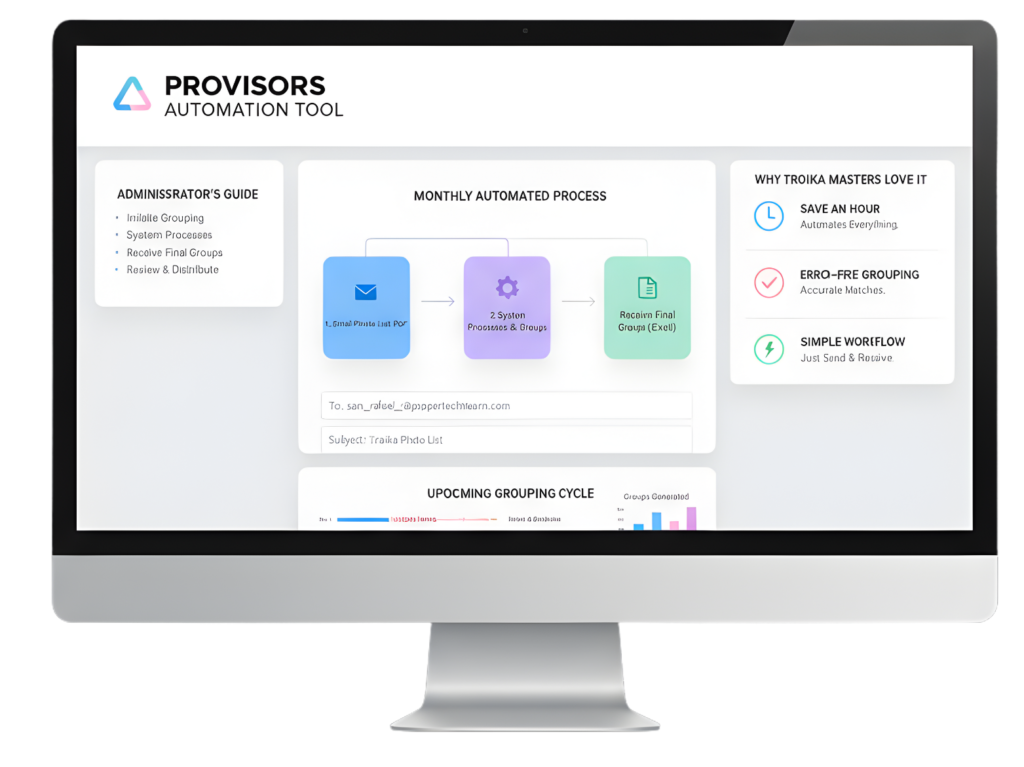
Step 1: Data Input

Member information and preferences are submitted to the system through a structured format. This eliminates the need for scattered data sources or manual consolidation.

Step 2: Automated Processing

The system applies grouping logic based on predefined rules. It evaluates all inputs simultaneously, ensuring optimal group formation without conflicts.

Step 3: Validation Layer

Before finalizing outputs, the system runs checks to ensure accuracy. This includes verifying member inclusion, eliminating duplicates, and validating constraints.

Step 4: Output Generation

Final groupings are generated instantly in a clean, ready-to-use format. This removes the need for manual formatting or adjustments.

Step 5: Distribution

Groups are shared seamlessly with stakeholders, ensuring timely communication and a smooth experience for all participants.

What once required hours of effort now takes less than 5 minutes from start to finish.

Results & Measurable Impact

The transformation delivered immediate and measurable results across multiple dimensions.

Operational Efficiency

  • Reduced process time from 1-2 hours to under 5 minutes per meeting
  • It tracks meeting history for the last 12 months
  • when applied across 600 groups, it can save approximately 600-1200+ hours annually
  • Eliminated repetitive administrative workload

This allowed teams to focus on higher-value activities instead of routine tasks.

Accuracy & Reliability

  • Achieved near 100% accuracy in group creation
  • Eliminated duplicate assignments and missed entries
  • Consistent results every month, regardless of complexity

The process became predictable and dependable.

Improved Experience

  • Reduced stress and last-minute pressure for administrators
  • Increased confidence in the system’s output
  • Delivered a better experience for members through accurate groupings

The shift wasn’t just operational; it improved how people felt about the process.

Scalability & Growth Readiness

  • Easily supports growing member volumes without added effort
  • No additional time required as complexity increases
  • Flexible enough to adapt to new requirements or rules

The process is now future-ready.

Why This Matters Beyond Troika

The Troika process is just one example, but the insight applies broadly.

Every organization has workflows that:

  • Repeat on a schedule
  • Follow defined rules
  • Require coordination across data or people

These processes are often handled manually simply because “that’s how it’s always been done.”

AI-powered workflow automation challenges that assumption.

It enables businesses to:

  • Identify hidden inefficiencies
  • Replace manual effort with intelligent systems
  • Create consistent, scalable operations

The real opportunity isn’t just fixing one workflow; it’s transforming how work gets done across the organization.

Final Thought

The Troika transformation highlights a simple truth:

👉 If a process repeats, it can be automated.

Instead of optimizing manual effort, organizations can rethink how work is executed entirely.

Blog

The compounding power of AI: How small workflow wins add up to big productivity gains

Every team has them, those tiny, nagging tasks that seem harmless until they start eating up the day. Forwarding documents. Scheduling check-ins. Updating some tracker that no one quite remembers why it exists. None of these tasks feel like “real work,” yet they silently drain energy, attention, and momentum. 

Now imagine if these background tasks could simply take care of themselves. Not because you hired more people or installed another cumbersome platform, but because AI quietly took over the routine, allowing the humans to focus on the parts that actually require thought, empathy, and creativity. 

That’s not science fiction anymore. It’s the daily reality of AI-powered workflow automation, an invisible layer of intelligence woven through everyday processes. The true magic lies not in one big breakthrough but in small workflows automated systematically across an organization. Each one might save a few minutes here and there, but over weeks and months, those wins start stacking up. 

That’s the compounding power of AI in motion; small optimizations accumulating into massive productivity gains that reshape how an organization works. 

The quiet cost of tiny inefficiencies

Most people think the biggest threats to productivity are distractions; emails, meetings, or social media. But often, the real culprit is something quieter: small, repetitive actions that feel too minor to fix. 

Individually, they seem inconsequential. A status update here, a file upload there, ten minutes tracking down who’s responsible for a task. But multiply those by the number of employees and projects across a company, and the hours lost every week become staggering. 

This is what some call “micro-friction,” a thousand little moments of manual effort that slow down progress in invisible ways. It’s also where AI shines, because it’s incredibly good at handling micro-decisions that humans find mentally exhausting. 

When those micro-frictions disappear, teams start to notice something refreshing. Work feels lighter. Projects move faster. And the day suddenly opens up space for deeper thinking. That’s when AI begins to earn its keep, not by automating jobs, but by returning time to the people doing them. 

Why small automations have exponential impact

When you think about transformation, it’s easy to picture a sweeping overhaul, the kind that involves massive technology investments and months of change management. But that’s rarely where real transformation begins. 

Most successful automation journeys start small; one workflow at a time. 

It might be automating onboarding emails, synchronizing updates between databases, or notifying the right person when a task changes status. These aren’t headline actions. They’re quiet wins. Yet small automations like these behave a lot like compound interest in finance, steady, incremental, and profoundly powerful over time. 

A team that saves ten minutes a day per person ends up reclaiming over 40 hours a year per employee. Multiply that by 50 employees, and that’s an extra 2,000 hours, almost a full work year, restored for higher-value activities. 

The secret is consistency. Instead of chasing one massive automation project, the most effective companies stack small wins strategically. Over time, these compounding efficiencies create new organizational momentum that no single tool could deliver alone. 

The compounding effect in motion

So, what does compounding really look like in everyday work? Picture this: 

  • An HR manager automates offer letter creation. That’s a 15-minute task saved per new hire. 
  • The same team automates follow-up notifications for onboarding sessions. Another 30 minutes a week, per person. 
  • Finance automates expense approvals based on predefined rules. There goes an hour. 
  • Project teams start using AI to summarize meeting notes and update action items automatically. Another small chunk of time, saved with every meeting. 

None of these are dramatic changes in isolation. But together, they create momentum. Workflows no longer exist in silos; they start feeding into each other. That’s the compounding effect; every improvement becomes a foundation for the next one. 

Before long, teams realize the benefits aren’t just measured in hours saved, but in mental clarity and operational flow. The effort once spent chasing small tasks now fuels strategic work, innovation, and collaboration. 

Automating what’s repeatable, not what’s meaningful

A key principle behind successful automation is knowing what not to automate. 

You don’t automate human judgment. You don’t delegate empathy, negotiation, or creativity to algorithms. What you automate are the processes that repeat, the ones that don’t need rethinking each time. 

AI excels at identifying patterns and executing consistent tasks with precision. That means it can handle scheduling, data validation, document preparation, notifications, or even complex routing between tools. But the point isn’t to remove the human; it’s to support them. 

When the mundane disappears, people rise to higher levels of contribution. A sales team can focus more on relationships than reports. A marketing team can experiment with ideas instead of formatting endless spreadsheets. And operations no longer feel like traffic controllers for tasks that could run themselves. 

Automation, done well, doesn’t dehumanize work. It restores humanity to it. 

The art of spotting automation opportunities

Organizations often think they need advanced AI talent to begin automating workflows. In reality, they just need curiosity, a willingness to observe daily processes and ask: 

  • “Does this need a person’s creativity, or could a system handle it?” 
  • “If this step repeats more than a few times a week, can we teach AI to do it?” 
  • “What’s slowing people down that doesn’t actually require judgment?” 

From there, it becomes a matter of mapping workflows and identifying what’s routine, rule-based, or depends on data from another system. Those are prime candidates for automation. 

For example: 

  • Syncing client updates between CRM and invoicing software. 
  • Auto-generating summaries or reports from meeting transcripts. 
  • Sending internal updates when a milestone is met. 
  • Gathering feedback or tracking form submissions automatically. 

Each automation is small, but together they form a seamless web of AI-powered efficiency, a digital backbone that keeps an organization humming without extra effort. 

Culture shifts when automation becomes habit

One fascinating ripple effect of automation is cultural. When a company begins to systematically automate repetitive work, it doesn’t just gain efficiency; it changes how people think about work. 

Early on, teams feel relief: “Finally, one less task to track!” But soon after, they start to see the bigger picture. Colleagues begin spotting other small processes that could be improved. Innovation becomes part of everyone’s mindset, not just IT’s job. 

That shift; from “we have tools” to “we continuously improve” is where compounding truly takes off. 

It’s not a one-time boost; it’s a flywheel that keeps spinning. Over time, this mindset reduces burnout, sharpens focus, and inspires employees to own their workflows. The thrill of saving fifteen minutes here and twenty minutes there becomes contagious because those minutes start translating into visibly better teamwork, communication, and creativity. 

Compounding productivity isn’t just math, it’s psychology

When automation begins freeing up time, something subtle changes in how people approach work. Suddenly, they feel ahead of their schedule instead of behind it. Their attention shifts from firefighting to foresight. 

This change has an enormous psychological effect. Small wins build confidence. Confidence builds engagement. And engaged employees naturally look for more improvements. 

The cumulative result is organizational momentum, a sense that everything’s flowing just a bit more smoothly than before. Systems feel lighter, communication is faster, and energy doesn’t evaporate on administrative drains. 

The compound effect, in other words, isn’t just in the minutes saved; it’s in the quality of thought and performance that those minutes enable. 

Building your compounding automation strategy

There’s no single formula for automating effectively. But nearly every successful organization follows a few guiding steps: 

  1. Start with visibility. 
    You can’t automate what you can’t see. Map workflows, understand dependencies, and pinpoint where time quietly disappears. 
  2. Automate something small first. 
    Pick a workflow that’s repetitive, low-risk, and frequent. When it works well, confidence and trust in automation grow naturally. 
  3. Document every success. 
    Each small automation is proof that the process can improve. It builds a playbook for future automation. 
  4. Focus on interconnected wins. 
    Once individual workflows run smoothly, explore linking them. That’s where compounding really happens, when one automation triggers another. 
  5. Keep humans in the loop. 
    Use AI as an assistant, not an authority. Human review, judgment, and creativity remain essential for meaningful decision-making. 
  6. Measure not just time saved, but time repurposed. 
    The best returns come when freed-up time fuels innovation, not just more busywork. Make reflection part of the ROI. 

The most powerful automations feel invisible

Interestingly, the best automation systems rarely draw attention to themselves. They just work. 

You notice them only when they’re gone, when a reminder doesn’t send or a report isn’t ready on time. That’s because well-designed AI workflows integrate silently, without disrupting the flow of human work. 

Think of them as backstage crew in a production, invisible, yet indispensable. They keep everything synchronized so the people onstage, your employees, can focus on delivering the performance, not worrying about logistics. 

The future of AI automation isn’t a dashboard of bots running everything. It’s an ecosystem where human creativity thrives precisely because everything else quietly runs on autopilot. 

The hidden math of compounding time

Let’s take a simple example. 

Imagine a five-person operations team where each employee automates just three small workflows, scheduling weekly status emails, auto-generating weekly summaries, and logging completed tasks automatically. Let’s assume each one saves 30 minutes a day. 

That’s 2.5 hours saved per person daily; 12.5 hours per day across the team. 
Multiply that by a 50-week work year, and you have over 600 hours reclaimed. 

Now extend that across departments and connect those automations say, between operations, finance, and client teams, so updates flow seamlessly between systems. Those hours compound again through reduced follow-ups, fewer errors, and faster handoffs. 

This is why compounding automation feels less like magic and more like math in motion; small, calculable gains that expand exponentially once systems start working together. 

Human creativity thrives when AI takes the wheel for routine work

Despite what some fear, the rise of AI in workflows doesn’t make humans less essential; it highlights what makes them irreplaceable. 

When people no longer have to obsess over tracking, copying, and verifying small details, they return to thinking big. They can focus on innovation, strategy, relationships, and leadership. The kind of work machines can’t define but can amplify. 

Some of the most forward-thinking companies understand this deeply. They don’t look at AI as a product; they see it as a partner. The goal isn’t to “install automation” but to build a culture of intelligent delegation, giving machines the repetitive, rule-based work so people can do the emotional, strategic, and creative work that only they can. 

That’s the elegant balance of the modern workplace: humans leading, AI supporting. 

The quiet revolution of everyday AI

There’s no single turning point in the shift toward automated workflows. It doesn’t happen overnight, and it doesn’t require an expensive reinvention. 

It begins with one simple realization: your time is compounding, whether you manage it or not. Every wasted minute adds up; every saved one multiplies. 

AI workflow automation is how companies turn that math to their advantage by designing systems that get smarter and faster with every process they take on. 

The revolution isn’t loud. It’s quiet, consistent, and deeply human at its core. People thrive when they can spend their energy where it matters most. AI simply clears a path for that to happen. 

A final thought

The compounding power of AI doesn’t come from one big leap; it comes from hundreds of tiny ones. 

Each saved click, each automated update, each smoother handoff, together, they build something extraordinary: an organization that doesn’t just work faster but works better. 

In the end, that’s the ultimate goal. Not automation for its own sake. Not replacing humans. But creating the kind of workplace where time flows more freely, creativity flourishes, and progress compounds quietly, one workflow at a time. 

Scroll to Top